
Hercules
The sections below are merged from companion Markdown notes for the same case. They are rendered after sanitization so the article stays precise without publishing raw flags, credentials, or target-specific secrets. Target: Hercules IP: <TARGET>...
Scenario
Hercules attack path
The sections below are merged from companion Markdown notes for the same case. They are rendered after sanitization so the article stays precise without publishing raw flags, credentials, or target-specific secrets. Target: Hercules IP: ...
Objective
Machine walkthrough focused on Machines evidence, validation, and reusable operator lessons.
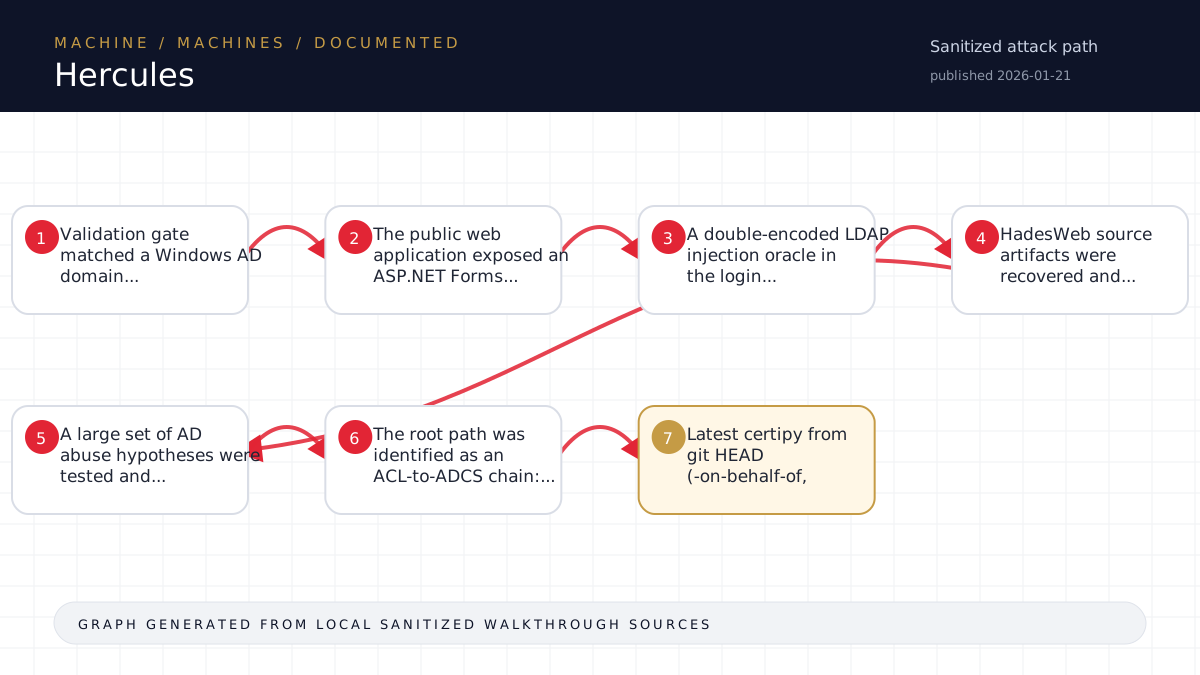
Walkthrough flow
Validation gate matched a Windows AD domain...
The public web application exposed an ASP.NET Forms...
A double-encoded LDAP injection oracle in the login...
HadesWeb source artifacts were recovered and...
A large set of AD abuse hypotheses were tested and...
Source coverage
High source coverage
Status: complete. This article is generated from 7 sanitized Markdown sources and keeps raw flags, credentials, keys, cookies, and reusable secrets out of the rendered blog.
High confidence: the page is reconstructed from a primary walkthrough plus multiple supporting notes or evidence sources. Treat the chain as source-backed, while still checking the listed source files for sensitive values.
- <TARGET>-Hercules/walkthrough.md
- HTB/<TARGET>-Hercules/notes.md
- HTB/<TARGET>-Hercules/attack-map.md
- HTB/<TARGET>-Hercules/memory-summary.md
- HTB/<TARGET>-Hercules/session-resume.md
- HTB/<TARGET>-Hercules/custom-exploit-notes.md
- HTB/<TARGET>-Hercules/dead-ends.md
Technical Walkthrough
Hercules Walkthrough
Source-Backed Dossier
The sections below are merged from companion Markdown notes for the same case. They are rendered after sanitization so the article stays precise without publishing raw flags, credentials, or target-specific secrets.
Notes
Target: Hercules
IP: <TARGET>
OS/Difficulty: Windows / Insane
Pwnbox: <TARGET> (profex0r)
Attacker VPN IP: pending validation
Started: 2026-05-07T18:19:10Z
Scope: Authorized HackTheBox machine only
Evidence Ledger
| Time UTC | Command / Action | Output File | Finding | Confidence | Next Action |
|---|---|---|---|---|---|
| 2026-05-07T18:19:10Z | Created workspace and advisory pre-research | Hercules-PreResearch/research.md | Public claims recorded as unvalidated | Medium | Validate live anchors from Pwnbox |
| 2026-05-07T18:21:00Z | Pwnbox setup + ping target | Pwnbox enum/pwnbox-interfaces.txt, enum/ping-target.txt | Pwnbox VPN IP <TARGET>; target reachable with TTL 127 | High | Run validation scans |
| 2026-05-07T18:21:00Z | Expected-port TCP scan | Pwnbox nmap/expected-quick.nmap | AD/DC expected ports open: 53, 80, 88, 135, 139, 389, 443, 445, 464, 593, 636, 3268, 3269, 5986, 9389 | High | Validate domain and web stack |
| 2026-05-07T18:25:00Z | HTTP/TLS/LDAP/SMB baseline | Pwnbox enum/http-headers.txt, enum/https-cert.txt, enum/ldap-rootdse.txt, enum/smb-null-guest.txt | IIS 10 confirmed; TLS SAN hercules.htb; LDAP RootDSE confirms dc.hercules.htb and DC=hercules,DC=htb; SMB signing required; null/guest returns <secret redacted> | High | Add hosts and fingerprint web |
| 2026-05-07T18:28:00Z | Service/version scan | Pwnbox nmap/services.nmap | Host DC, Windows, AD LDAP/Kerberos, WinRM SSL, high RPC; clock skew ~4m30s | High | Proceed with advisory chain as validated hypothesis |
| 2026-05-07T18:28:00Z | Web baseline | Pwnbox enum/https-index.html, enum/web-index-summary.txt, enum/web-quick-paths.txt | Hercules Corp ASP.NET/IIS app; /Login exposes Hercules SSO with anti-CSRF token and client username regex | High | Build controlled login/LDAP injection oracle tests |
| 2026-05-07T22:27:17Z | /Login LDAP oracle extraction | Pwnbox enum/description-*, local loot/oracle-current-prefix.txt | Double-encoded LDAP filter injection confirmed. description prefix extraction produced a credential-like value; exact value still incomplete. | High | Resume from saved prefix, avoid broad scans, continue targeted extraction after Pwnbox returns |
| 2026-05-07T22:27:17Z | Pwnbox health check | SSH to <TARGET> | Pwnbox SSH timed out; local machine has no route to <TARGET>. Live exploitation paused on infrastructure, not target logic. | High | Restart/restore Pwnbox or provide new IP |
| 2026-05-08T01:49:06Z | New Pwnbox validation | SSH to <TARGET> | Pwnbox reachable; VPN IP <TARGET>; route to <TARGET>/16 present; core tools available | High | Rebuild Pwnbox workspace and validate new target IP |
Validation Gate
| Anchor | Expected | Status | Evidence |
|---|---|---|---|
| Target reachable over HTB VPN | <TARGET> live | MATCHED | Pwnbox enum/ping-target.txt |
| Windows DC-like service set | DNS/Kerberos/LDAP/SMB/RPC/WinRM SSL | MATCHED | Pwnbox nmap/services.nmap |
| Domain | hercules.htb | MATCHED | Pwnbox enum/ldap-rootdse.txt, enum/https-cert.txt |
| Hostname | dc.hercules.htb / DC | MATCHED | Pwnbox enum/ldap-rootdse.txt, nmap/services.nmap |
| Web stack | IIS/ASP.NET on 80/443 | MATCHED | Pwnbox enum/http-headers.txt, enum/web-index-summary.txt |
| TLS certificate | CN/SAN hercules.htb | MATCHED | Pwnbox enum/https-cert.txt |
| LDAP/SMB posture | NTLM may be disabled/restricted | PARTIAL MATCH | Pwnbox enum/smb-null-guest.txt shows <secret redacted>; more auth testing needed |
| AD CS surface | CA/templates | <secret redacted> | Requires credentials or deeper enumeration |
Gate decision: 6+ core anchors matched. Public research is credible enough to use as advisory guidance, but every exploitation step still requires live proof.
Attack Map
Hosts
| IP | Hostname | OS | Status | Reachable From |
|---|---|---|---|---|
| <TARGET> | dc.hercules.htb / DC | Windows DC | pending revalidation | Pwnbox |
Services
| Host | Port | Service | Version | Auth | Notes |
|---|---|---|---|---|---|
| dc.hercules.htb | 53 | DNS | Simple DNS Plus | n/a | AXFR denied |
| dc.hercules.htb | 80 | HTTP | Microsoft IIS 10.0 | public | Redirects to HTTPS |
| dc.hercules.htb | 88 | Kerberos | Microsoft Windows Kerberos | domain | Clock skew about 4m30s |
| dc.hercules.htb | 389/636/3268/3269 | LDAP/GC | Active Directory LDAP | bind required for subtree | RootDSE anonymous allowed |
| dc.hercules.htb | 443 | HTTPS | Microsoft IIS 10.0 / ASP.NET | public | Hercules Corp; /Login SSO form |
| dc.hercules.htb | 445 | SMB | SMB2/3 | null/guest rejected | Signing required; <secret redacted> with null/guest |
| dc.hercules.htb | 5986 | WinRM SSL | Microsoft HTTPAPI 2.0 | creds required | Candidate later auth surface |
| dc.hercules.htb | 9389 | ADWS | .NET Message Framing | creds required | AD management surface |
Credentials
| Source | Username | Secret | Type | Tested On | Result |
|---|
Attack Paths
| # | Path | Status | Evidence |
|---|---|---|---|
| 1 | Public advisory: web LDAP injection -> FormsAuth/LFI -> ADCS/shadow creds -> RBCD | anchors matched / exploitation pending | notes.md Validation Gate |
| 2 | Live /Login LDAP oracle -> extract credential-bearing LDAP attributes -> initial domain auth | active | Pwnbox enum/description-*, local loot/oracle-current-prefix.txt |
| 3 | Pure live recon fallback: ASP.NET SSO + AD enumeration from web only | active backup | Pwnbox enum/web-index-summary.txt |
Trust Edges
None confirmed.
Memory Summary
Platform: HackTheBox
Machine: Hercules
Difficulty/OS: Insane / Windows
Purpose: Sanitized operational memory for future HTB, AD, ASP.NET, document-processing, and ADCS work.
Sanitization policy - Raw flags, reusable <password redacted>, hashes, tickets, PFX material, and Pwnbox credentials are not included here.
Outcome State
- User flag was captured from the live target. The raw flag is intentionally omitted.
- Root was not complete at the time of this summary, but the root path was identified and partially validated.
- The engagement produced high-value negative evidence: many plausible Insane Windows AD branches were closed with live tests instead of assumptions.
High-Level Chain
- Validation gate matched a Windows AD domain controller with IIS/ASP.NET, LDAP/Kerberos/SMB/WinRM, ADWS, and ADCS-relevant surfaces.
- The public web application exposed an ASP.NET Forms Authentication flow backed by LDAP.
- A double-encoded LDAP injection oracle in the login flow was confirmed and used for controlled AD attribute extraction. Broad extraction was noisy; small anti-CSRF-aware probes with cooldowns were more reliable.
- HadesWeb source artifacts were recovered and decompiled. The source review closed the web branch: only three controllers were present, no hidden privileged routes existed, and the relevant LDAP lookup used
sAMAccountName, notcnorname. - A large set of AD abuse hypotheses were tested and closed before the correct post-user path was identified.
- The root path was identified as an ACL-to-ADCS chain: an account with
WriteDaclon a migration OU can grant inheritable control over a disabled Smartcard Operators user, enable/reset that user, obtain an enrollment-agent certificate, then use ESC3 on-behalf-of enrollment for an administrator certificate.
Root Path Lesson
The important strategic lesson is that the intended bridge was not the document processor, web app, RBCD, password cracking, or direct GenericWrite abuse. It was an inherited OU DACL path into an ADCS enrollment role.
Validated root-path components:
WriteDaclon an OU can be enough when the useful target is a child object and the ACE is inheritable.- After adding the correct inheritable ACE, enabling the disabled user and resetting its password worked.
- The enabled user had the ADCS role needed to enroll an enrollment-agent certificate.
- The remaining blocker was tooling for ESC3 on-behalf-of enrollment, not the attack path.
Tooling lesson:
- When Certipy fails during ESC3 on-behalf-of enrollment with Kerberos/RPC transport errors, do not immediately abandon the path.
- Switch tool family: use Windows-native Certify for
request-agent/ on-behalf-of enrollment, then Rubeus for certificate-to-TGT, or test the latest Certipy from a clean virtual environment. - Treat
certreqover unstable WinRM as a fallback; it is more brittle than a single-purpose ADCS tool.
Closed Branches and Reusable Reasons
LibreOffice / ODT Document Execution
- ODT files were consumed by a document processor and lock files appeared, proving the processor opened documents.
- Macro/script payloads, LibreLogo, OLE, DDE, external references, XXE-style document tricks, and known LibreOffice document vectors produced no execution and no callbacks.
- Best explanation: headless conversion mode. Headless LibreOffice conversion can open documents without firing interactive document events.
- Future rule: if only lock files appear and all macro/callback canaries fail, close document execution quickly and pivot.
SMB Workflow Canaries
- SCF,
desktop.ini, URL shortcut, and script canaries in writable shares produced no SMB or HTTP callbacks. - This indicates no user or service was browsing the share through Explorer.
- Future rule: use canaries early to prove whether a human/service workflow exists before spending hours on file-trigger payloads.
ASP.NET Source Branch
- Decompiled source is stronger evidence than route fuzzing alone.
- The recovered HadesWeb assembly showed no hidden controllers, no cleanup workflow, no password reset, no AD management function, and no
cn/namelookup. - FormsAuth roles were forgeable from cookie user data, but no privileged app functionality existed to unlock.
- Rule - a forgeable role cookie is only useful if source or live routes prove an authorization boundary worth crossing.
GenericWrite and AD Rights
- GenericWrite did not imply ForceChangePassword. Resetting
unicodePwdrequires the ForceChangePassword extended right. - GenericWrite did not allow setting constrained delegation attributes in this case.
- Some tool output that looked like broad
WRITEwas only limited name/RDN-style write capability. - Future rule: verify AD rights with the exact attribute or extended-right write needed; do not trust generic labels from one tool.
RBCD Between User Accounts
- User-to-user RBCD could mechanically produce a delegated ticket, but the ticket was encrypted with the controlled user's key, not the DC service key.
- The result failed against DC services.
- Future rule: RBCD is only useful when the target service account actually backs the service you need, such as a computer account for CIFS/LDAP/HTTP on that host.
KCD
- Attempts to set
msDS-AllowedToDelegateToand related delegation flags failed with insufficient rights or invalid syntax. - Future rule: do not conflate write access to ordinary user attributes with delegation control.
ADCS Direct Enrollment and UPN Spoofing
- Direct enrollment into privileged templates was denied until the Smartcard Operators path was unlocked.
- UPN spoofing plus certificate enrollment worked mechanically, but strong certificate binding mapped the certificate back to the requester because the SID extension was present.
- No useful template had the no-security-extension behavior required for the common ESC9-style bypass.
- Future rule: if SID extension strong mapping is enforced, UPN spoofing is not enough. Look for role/template abuse, enrollment agent paths, CA policy weaknesses, or actual SID-less templates.
ESC14 / Signature Chain
- Template signature requirements were checked and did not create a useful chain.
- Future rule: only pursue ESC14-style paths when a template actually requires authorized signatures and a controlled certificate can satisfy that requirement.
Kerberoast / Password Spray
- Targeted Kerberoasting and password/hash spraying against high-value accounts failed with standard wordlists and custom guesses.
- Future rule: on Insane boxes, cracking/spraying is a hypothesis, not a default sink. Timebox it and move back to graph-backed privilege paths.
Machine Account Creation
- Machine account creation was blocked by quota even when OU-level create-child looked promising.
- Future rule: confirm
MachineAccountQuotaand live computer creation before planning RBCD around new machine accounts.
IIS Kerberos and Client Cert Auth
- IIS did not advertise Negotiate and did not request client certificates.
- Future rule: RBCD/PKI web-auth pivots need live auth surface proof. Check
WWW-Authenticateand TLS client certificate request behavior before assuming they exist.
Harness / Workflow Lessons
- The v3 harness was valuable once it forced branch closure: checkpoint packet, RAG queries, retrieval tags, and evaluator pass justified asking for a targeted hint.
- The hint threshold was appropriate after many closed branches with evidence and no remaining ranked hypothesis.
- The correct use of LightRAG here is not to ask for the exact box answer; it is to retrieve prior patterns and then mark results as
MATCHED,MISSING, orGENERIC. - Keep active workspace as source of truth. RAG is advisory memory and should not override live evidence.
Future Query Triggers
Use this summary when a future target includes any of these patterns:
ASP.NET FormsAuthplus LDAP-backed login or LDAP injection oracle.HadesWeb-style source disclosure or recovered.dll/.pdbfrom IIS.- Writable SMB share with document processor but no callbacks.
- LibreOffice lock files without macro execution.
- AD rights where
GenericWrite, limitedWRITE, orWriteDaclappear ambiguous. - OU
WriteDaclwith disabled child users or privileged role groups. - ADCS ESC3 / enrollment-agent path with Certipy transport failures.
- UPN spoofing blocked by SID extension strong certificate mapping.
- User-to-user RBCD producing a ticket that fails against DC services.
New Session Findings (Multi-Agent Collaboration)
OU Object Move via Raw LDAP ModifyDN
- Technique: bob.w (Recruitment Managers) has CreateChild/DeleteChild on multiple OUs. Used raw ASN.1 BER-encoded LDAP ModifyDN to move stephen.m from Security Department OU to Web Department OU.
- Effect: natalie.a's inherited GenericWrite (scoped to Web Department OU) now applies to stephen.m.
- Tool gap: No standard Linux offensive tool (bloodyAD, impacket, certipy, ldap3 with GSSAPI) supports Kerberos-authenticated LDAP ModifyDN. Required building the ModifyDN request as raw BER bytes and sending through impacket's LDAPConnection socket.
- BER encoding: Application tag 12 (0x6C), with entry DN, new RDN, deleteoldrdn boolean, and context-tagged [0] newSuperior.
bob.w Writable Scope Was Larger Than Initially Known
- bloodyAD
get writableas bob.w revealed WRITE on ALL Security Department users (auditor, mark.s, stephen.m, vincent.g, nate.h, elijah.m, angelo.o) AND all Engineering Department users. Previous analysis only checked natalie.a's scope. - The WRITE was limited to name/cn WriteProperty only (not GenericWrite) — shadow creds, RBCD, SPN, and attribute writes all denied on these users.
- The CreateChild/DeleteChild on OUs was the actual useful right, enabling the OU move technique.
Cleanup Timer Details
- Cleanup script runs every ~10 minutes on the DC.
- Resets: dsacls ACEs on Forest Migration OU, disables fernando.r, resets his password.
- Minimum password age policy: ~3 minutes between password changes. Must wait after cleanup before resetting fernando.r's password.
- Race condition: entire chain (dsacls → enable → wait 3 min → password reset → TGT → cert enrollment) must complete within ~10 minutes.
certreq Native Workflow
certreq -newrequires explicit ProviderName + ProviderType in INF to avoid interactive CSP dialog, plusSilent = TRUEandUserProtected = FALSE.certreq -signwith-cert <thumbprint>signs a PKCS10 request with the enrollment agent cert, creating a CMC on-behalf-of request.certreq -signconsistently crashes evil-winrm (malloc_consolidate). Requires stable interactive session (RDP/VNC).certutil -signwithout-certflag tries to open GUI cert picker, which fails via WinRM.
User/UserSignature Templates Enrollable by Domain Users
- Both templates have
Enrollment Rights: Domain Users— hidden from certipy's initial output. - Both have Client Authentication EKU.
- User template requires SubjectRequireEmail (Administrator has no email → enrollment fails).
- SmartcardUser requires SubjectRequireEmail too.
- SmartcardLogon does NOT require email but wasn't listed by Certify.exe enum-templates as available.
ADCS SID Extension Strong Binding
- All certificates issued by <secret redacted> embed OID <TARGET>.<TARGET>.2 with the requester's SID.
- certipy auth with
-domain -usernameflag gets client-side "Object SID mismatch" check. - PKINITtools gettgtpkinit.py bypasses client-side check but KDC returns <secret redacted> when SID doesn't match target.
- Shadow credential PKINIT always authenticates as the Key Credential owner regardless of UPN change.
Recommended Operator Behavior Next Time
- Build a graph of exact rights and object containment before spending time on payloads.
- For every AD edge, test the exact target operation, not just whether a tool labels an edge as writable.
- Use source-code decompilation to close web hypotheses early when assemblies are recovered.
- Canary workflow assumptions before developing document payloads.
- Separate strategic failure from tooling failure. If the graph and privileges prove the path, rotate tools before pivoting strategies.
- For ESC3, prioritize Certify plus Rubeus when Certipy on-behalf-of enrollment is unreliable.
ESC3 On-Behalf-Of Tooling Failure Map (Hercules-Specific)
This section documents the exact tooling failures encountered during ESC3 on-behalf-of enrollment when NTLM is globally blocked and the only session available is evil-winrm.
Known Failures
- certipy req -on-behalf-of with Kerberos: <secret redacted> (0x80010117) — Certipy RPC transport bug; fixed in later git commits. Always install certipy from git HEAD on Kerberos-only targets.
- certipy req -hashes: invalid_checksum when NTLM is blocked globally.
- Certify.exe via evil-winrm: malloc_consolidate crashes on SmartcardUser template and on certreq -sign. evil-winrm is not a stable host for memory-intensive certificate operations.
- certreq -new via evil-winrm: hangs on CSP interactive prompt. Requires Silent=TRUE + explicit ProviderName + ProviderType in INF file. Even with correct INF, certreq -sign crashes evil-winrm.
- certutil -sign without -cert flag: opens GUI cert picker, fails non-interactively.
Tooling Rotation Order for ESC3 on NTLM-blocked targets
- Latest certipy from git HEAD (-on-behalf-of, Kerberos only, from Pwnbox — no Windows session needed)
- pyForgeCert (Python-native CMC from Pwnbox — no Windows session needed)
- Enable RDP via short WinRM commands → certreq -sign interactively in RDP session
- wmiexec instead of evil-winrm for certreq staging (different memory profile, may avoid malloc crash)
Race Condition Pattern (Cleanup Timer)
- If a cleanup script resets target account state every N minutes, pre-stage ALL commands before starting the chain.
- Identify minimum password age policy before attempting password resets — waiting time must be factored into the race window.
- Measure cleanup cadence with at least two observations before committing to a timed chain.
WinRM Stability Pattern
- evil-winrm malloc_consolidate crashes occur on commands that involve large memory operations (certreq, certain PowerShell crypto operations).
- Use wmiexec.py for individual commands when evil-winrm is unstable.
- Keep each WinRM command short and stateless — avoid piping or chaining complex operations in one call.
- For stable interactive sessions on NTLM-blocked targets: enable RDP via short registry + firewall commands over WinRM, then use xfreerdp with Kerberos.
Current Engagement State (Root Not Yet Captured)
- User flag: captured.
- Root path: validated. The path is correct; only tooling execution remains.
- Enrollment agent cert: obtained and stored in loot/.
- Remaining step: ESC3 on-behalf-of Administrator cert → PKINIT → root flag.
- Recommended next tool: latest certipy from git HEAD, then pyForgeCert if that fails.
- All 17 dead-end branches documented in dead-ends.md — do not revisit.
Session Resume
Last updated: 2026-05-08T01:49:06Z
Current Access
- No target shell yet.
- Pwnbox validated:
<TARGET>, VPN<TARGET>. - Target validated as
dc.hercules.htb/hercules.htb, Windows AD DC, IIS/ASP.NET web surface. - Target IP has changed from
<TARGET>to<TARGET>; revalidate core anchors before resuming exploitation. /Logindouble-encoded LDAP injection oracle is confirmed. The active extraction target is thedescriptionattribute. The current credential-like prefix is stored inloot/oracle-current-prefix.txt.
Session Registry
| Name | Host | Command | Pane | Local Port | Remote Target | Status |
|---|---|---|---|---|---|---|
| hercules:recon | Pwnbox | expected/service scans | tmux hercules:recon | n/a | <TARGET> | expected scan interrupted; service scan complete |
| hercules:fullscan | Pwnbox | full TCP scan | tmux hercules:fullscan | n/a | <TARGET> | complete |
| hercules:oracle | Pwnbox | /Login anti-CSRF response-diff scripts | one-shot SSH/processes | n/a | https://hercules.htb/Login | needs rebuild on new Pwnbox |
Next Three Actions
- Rebuild Pwnbox workspace at
/home/profex0r/HTB/<TARGET>-Herculesand set/etc/hoststo<TARGET> hercules.htb dc.hercules.htb. - Validate target anchors on new IP, then resume targeted
descriptionextraction fromloot/oracle-current-prefix.txt; do not restart broad enumeration or fast single-session scripts. - Identify the owning account for the recovered value, test authentication quietly, then collect LDAP/BloodHound/Certipy evidence if credentials work.
Blockers
- The target web login oracle slows down under broad scans. Use small targeted probes with cooldowns.
Cleanup
- None yet.
Notes
State-Mutating Actions
No state-mutating actions performed yet.
Exploit Iterations
| Time UTC | Script/Technique | Result | Next Adjustment |
|---|---|---|---|
| 2026-05-07T22:27:17Z | login_probe.py and targeted /Login LDAP filter injection probes | Anti-CSRF aware login harness distinguishes MATCH vs NO via response text. description extraction is confirmed and partially recovered. | Continue from saved prefix using small targeted probes. Avoid ldap_oracle_enum_fast.py because it caused noisy/rate-limit behavior. |
Dead Ends
Document Macro/Script Execution
- Hypothesis: LibreOffice opens ODTs → macro/script → code execution as natalie.a
- Tested: 16+ payloads: Basic macros, Python macros, Shell(), SimpleFileAccess, SystemShellExecute, LibreLogo, <secret redacted>, <secret redacted>, <secret redacted>, OLE Package, XXE, text:section-source, DDE/DDEAUTO, draw:plugin, draw:applet, .uno:RunMacro, settings.xml MacroExecutionMode override
- Why it failed: Headless mode — no events, macros, or interactive features fire
- Revisit if: Processor mode changes from headless to interactive
Outbound Callbacks from Document Processor
- Hypothesis: ODT with external references triggers HTTP/SMB callback
- Tested: HTTP image, SMB/UNC image, DOCX attached template, floating frame
- Why it failed: All outbound connections blocked from the processor
- Revisit if: Network policy changes
KCD (Constrained Delegation)
- Hypothesis: GenericWrite → set msDS-AllowedToDelegateTo + UAC delegation flag → impersonate to DC
- Tested: bloodyAD set on bob.w for both attributes
- Why it failed:
insufficientAccessRightson msDS-AllowedToDelegateTo;invalidAttributeSyntaxon UAC delegation - Revisit if: Never — GenericWrite confirmed not sufficient for these attributes
RBCD to DC
- Hypothesis: Set msDS-AllowedToActOnBehalfOfOtherIdentity on controlled user → S4U → DC access
- Tested: RBCD on bob.w with web_admin as delegatee; S4U2Self+Proxy with -force-forwardable; got administrator.ccache
- Why it failed: Ticket encrypted with bob.w's key, not DC's. <secret redacted> for all DC services. Confirmed no IIS Negotiate auth.
- Revisit if: A service account running under a controlled user is discovered
ADCS Enrollment (Direct)
- Hypothesis: Enroll in SmartcardLogon/SmartcardUser/EnrollmentAgent template
- Tested: certipy req as natalie.a for SmartcardLogon
- Why it failed: <secret redacted> — only Smartcard Operators/Domain Admins can enroll
- Revisit if: We gain Smartcard Operators membership
ESC8 NTLM Relay to ADCS
- Hypothesis: Relay NTLM auth to ADCS web enrollment
- Tested: Previous LLM confirmed NTLM relay returns <secret redacted>
- Why it failed: NTLM restricted on target
- Revisit if: NTLM restriction is lifted
ESC9/ESC10 UPN Spoofing
- Hypothesis: Change UPN → enroll cert with spoofed UPN → PKINIT as target
- Tested: Changed bob.w UPN to <email redacted>; enrolled cert (SUCCESS); PKINIT via PKINITtools and certipy
- Why it failed: SID extension (OID <TARGET>.<TARGET>.2) in cert enforces strong binding. <secret redacted>. Certipy: "Object SID mismatch"
- Revisit if: <secret redacted> is found on a template (ESC9) or CA disables SID extension (ESC16)
ESC14 Signature Chain
- Hypothesis: UserSignature cert satisfies issuance requirement for another template
- Tested: Checked Authorized Signatures Required on ALL 18 enabled templates
- Why it failed: ALL templates have AuthorizedSignaturesRequired=0 — no template requires signatures
- Revisit if: Never
ForceChangePassword via GenericWrite
- Hypothesis: GenericWrite includes ResetPassword extended right → change auditor's password
- Tested: bloodyAD set password (LDAP REPLACE) on harris.d (known GenericWrite target) AND auditor (bob.w WRITE target), with and without -s (SSL)
- Why it failed: GenericWrite ≠ ForceChangePassword. Separate ACEs. LDAP REPLACE denied for both.
- Revisit if: Never — confirmed architectural limitation
Shadow Credentials on Non-Web-Dept Users
- Hypothesis: bob.w WRITE on auditor includes msDS-KeyCredentialLink
- Tested: certipy shadow auto on auditor, mark.s, stephen.m via bob.w
- Why it failed: <secret redacted> — bob.w WRITE is only WriteProperty on name/cn, not GenericWrite
- Revisit if: Never
Password Spraying
- Hypothesis: Shared NT hash or known <password redacted> reused by high-value targets
- Tested: 3 NT hashes + 2 plaintext <password redacted> sprayed against 14 targets (ashley.b, auditor, all helpdesk, admin, IIS accounts)
- Why it failed: All <secret redacted> — no password reuse
- Revisit if: New credentials discovered
Kerberoast (Targeted)
- Hypothesis: Crack controlled users' <password redacted> via TGS tickets → spray plaintext
- Tested: Set SPNs on all 5 Web Dept users, captured 5 TGS tickets, cracked with rockyou + best64 rules + hashcat + custom wordlist
- Why it failed: 0/5 cracked — <password redacted> resist standard wordlists
- Revisit if: Better wordlist or specific password pattern discovered
Machine Account Creation
- Hypothesis: OU-level CreateChild bypasses MachineAccountQuota=0
- Tested: bloodyAD add computer + impacket-addcomputer in Web Dept and Security Dept OUs
- Why it failed: <secret redacted> regardless of OU CreateChild
- Revisit if: Never
IIS Kerberos/Negotiate Auth
- Hypothesis: Web app accepts Kerberos auth → RBCD ticket usable against HTTP service
- Tested: curl with --negotiate on all endpoints; checked all response headers
- Why it failed: No WWW-Authenticate/Negotiate header on any endpoint. FormsAuth only.
- Revisit if: Never
Client Certificate Auth
- Hypothesis: IIS requests client certificates → use enrolled cert for auth
- Tested: openssl s_client on 443 and 5986
- Why it failed: "No client certificate CA names sent" — not configured
- Revisit if: Never
SMB Workflow Canaries
- Hypothesis: SCF/desktop.ini/URL/aCleanup.ps1 in Reports triggers callback from browsing user
- Tested: Planted @canary.scf, desktop.ini, canary.url, aCleanup.ps1 in Reports; monitored SMB+HTTP for 3+ minutes
- Why it failed: Zero callbacks. Only LibreOffice headless opened the ODT. No user/service browses Reports.
- Revisit if: Evidence of a folder-browsing user/service appears
cn/name Rename as Web App Primitive
- Hypothesis: Renaming Security Dept user CN influences web app LDAP lookup
- Tested: DLL strings analysis confirms only sAMAccountName in LDAP filter. No cn/name lookup in code.
- Why it failed: App uses sAMAccountName exclusively. cn/name change has no app-side effect.
- Revisit if: Second DLL or IIS module discovered that uses cn