
FFModule
FFModule is a sanitized challenge note from the local HTB archive, organized for quick review by category, difficulty, evidence flow, and reusable operator
Scenario
FFModule attack path
FFModule is a sanitized challenge note from the local HTB archive, organized for quick review by category, difficulty, evidence flow, and reusable operator
Objective
Challenge walkthrough focused on Reversing evidence, validation, and reusable operator lessons.
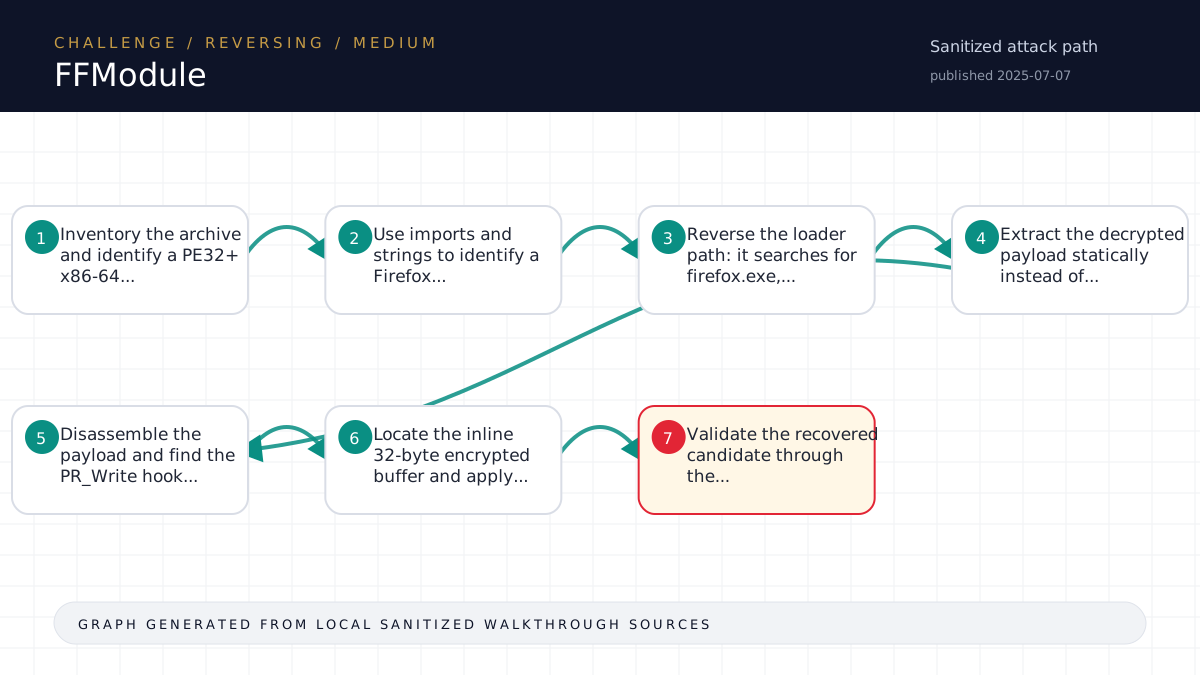
Walkthrough flow
Inventory the archive and identify a PE32+ x86-64...
Use imports and strings to identify a Firefox...
Reverse the loader path: it searches for firefox.exe,...
Extract the decrypted payload statically instead of...
Disassemble the payload and find the PR_Write hook...
Source coverage
High source coverage
Status: complete. This article is generated from 4 sanitized Markdown sources and keeps raw flags, credentials, keys, cookies, and reusable secrets out of the rendered blog.
High confidence: the page is reconstructed from a primary walkthrough plus multiple supporting notes or evidence sources. Treat the chain as source-backed, while still checking the listed source files for sensitive values.
- Reversing/FFModule/writeup.md
- htb-challenge/Reversing/FFModule/notes.md
- htb-challenge/Reversing/FFModule/memory-summary.md
- htb-challenge/Reversing/FFModule/hypothesis-board.md
Technical Walkthrough
Writeup
Challenge
- Name: FFModule
- Category: Reversing
- Difficulty: Medium
- Mode: file
Summary
FFModule is a Windows x64 Firefox malware module. The executable does not store
the flag as plaintext. Instead, it decrypts an embedded second-stage payload,
injects it into firefox.exe, and that payload contains a smaller encrypted
buffer.
The solve is fully static: extract the injected payload, locate the inline
32-byte encrypted buffer, and reproduce the payload's byte transform.
Artifact Inventory
files/a12c737e-e12c-465a-9797-a25458b787e9.zip: original HTB archive.files/extracted/rev_ffmodule/ffmodule.exe: PE32+ x86-64 Windows executable.
Analysis
Baseline imports showed a process injection pattern:
CreateToolhelp32Snapshot,Process32First,Process32NextOpenProcessVirtualAllocExWriteProcessMemoryVirtualProtectExCreateRemoteThread
The only useful plaintext strings were firefox.exe and the Firefox hook
banner. Disassembly around the string references showed that the program
searches for Firefox, decrypts 0x5a4 bytes from .data with XOR 0x72, and
injects the decrypted bytes.
The extracted second-stage payload contains its own resolver and hooks Firefox
PR_Write. It checks whether the outbound buffer starts with POST. Near the
network/send logic, the payload has a call +0x20 pattern; the 32 bytes after
that call are an encrypted inline buffer. The following decoder subtracts
0x13, rotates left by 3, then XORs with 0x42.
Public research was used only as a community hint and was validated against the
current artifact before use:
analysis/research/public-ffmodule-writeup-note.md
Local evidence:
analysis/objdump-p.txtanalysis/objdump-d.txtanalysis/payload-xor72.binanalysis/payload-capstone.txtanalysis/payload-strings.txt
Solve
Run:
python3 solve/solve.py --output loot/flag-candidate.txt
cd <local workspace>
python3 scripts/challenge_harness.py capture-flag Reversing/FFModule --from loot/flag-candidate.txt
The solver parses the PE section table, extracts .data, applies the loader's
XOR 0x72 stage, locates the inline 32-byte encrypted buffer, applies the
payload decoder, and writes the recovered flag candidate.
Flag
Raw flag is stored in loot/flag.txt and intentionally not reproduced here.
Lessons
- Malware-style reversing challenges often hide the real challenge logic in an
injected stage rather than the initial executable.
- Sparse strings are still enough to anchor analysis when paired with import
patterns and xrefs.
- Do not execute the sample unless necessary; this solve was completed with
static extraction and a small decoder.
Source-Backed Dossier
The sections below are merged from companion Markdown notes for the same case. They are rendered after sanitization so the article stays precise without publishing raw flags, credentials, or target-specific secrets.
Notes
Scope
- Challenge: FFModule
- Category: Reversing
- Difficulty: Medium
- Mode: file
- Remote instance: none
- Start time: 2026-06-13T02:05:12Z
- Operator: harness
- State file:
challenge-state.json
Harness Status
- Current phase: see
challenge-state.json - Next allowed actions: see
next-action.json - Raw flags and sensitive material stay in
loot/only. Do not paste them here.
Artifact Inventory
| File | Size | SHA256 | Type | Notes |
|---|---|---|---|---|
files/a12c737e-e12c-465a-9797-a25458b787e9.zip | 50517 | <hash redacted> | Zip archive data, at least v1.0 to extract, compression method=store | zip entries: 2 shown in artifact inventory JSON |
files/extracted/rev_ffmodule/ffmodule.exe | 98304 | <hash redacted> | PE32+ executable (console) x86-64, for MS Windows |
Evidence Ledger
| Time | Action | Output/File | Finding | Confidence | Next |
|---|---|---|---|---|---|
| 2026-06-13T02:05:12Z | harness init | challenge-state.json | Workspace initialized with deterministic state file | High | Inventory artifacts |
| 2026-06-13T02:05:32Z | artifact inventory | analysis/artifact-inventory.json | 2 artifact(s) inventoried | High | Build or update hypotheses |
| 2026-06-13T02:05:46Z | hypothesis recorded | hypothesis-board.md | Reverse ffmodule.exe as a Firefox credential-stealing module; identify how it locates/decrypts embedded or simulated Firefox secrets and recover the HTB flag from local artifacts. | Medium | Run file/strings/import inspection, identify PE/.NET/native packing, then build a local decoder or emulator for the secret-recovery logic. |
| 2026-06-13T02:05:46Z | checkpoint recorded | analysis/checkpoint-triage-20260613T020546535260Z-4ba29e66.md | Checkpoint for TRIAGE | High | Use checkpoint to drive next decision |
| 2026-06-13T02:06:25Z | RAG query | analysis/rag/rag-query-20260613T020606294456Z-272ac0de.txt | RAG helper exited 0; output saved | Medium | Record retrieval tag and validation |
| 2026-06-13T02:08:37Z | research record | analysis/research/research-records.md | Research tagged GENERIC | Medium | Validate against current evidence |
| 2026-06-13T02:08:37Z | instrumentation plan | analysis/instrumentation-plan.md | Recover the secret from the injected Firefox module payload without executing untrusted malware. | High | Stop if static extraction does not yield a payload-level decoder path; do not execute the PE or shellcode on the host. |
| 2026-06-13T02:11:53Z | evaluator | analysis/evaluator-20260613T021153899282Z-56b0cfcd.md | Proceed | High | capture-flag from loot/flag-candidate.txt |
| 2026-06-13T02:12:17Z | research record | analysis/research/research-records.md | Research tagged MATCHED | Medium | Validate against current evidence |
| 2026-06-13T02:12:26Z | flag capture | loot/flag.txt | HTB-format flag captured; raw value kept in loot only | High | Write solution and run completion gate |
| 2026-06-13T02:13:36Z | completion gate | challenge-state.json | Completion gate passed; state marked COMPLETE | High | Optional sanitized memory summary approval |
Key Findings
ffmodule.exeis a PE32+ x86-64 Windows console executable.- Imports include process-injection APIs:
OpenProcess,VirtualAllocEx,
WriteProcessMemory, VirtualProtectEx, and CreateRemoteThread.
- The module searches for
firefox.exeand prints/logs the Firefox hook banner. - The loader decrypts the first
0x5a4bytes of.datawith XOR0x72, then
injects that second-stage payload into Firefox.
- The second-stage payload hooks Firefox
PR_Write; it checks outbound buffers
for POST and contains an inline 32-byte encrypted buffer.
- The inline buffer decodes with the payload's byte transform:
rotate-left by 3 after subtracting 0x13, then XOR with 0x42.
solve/solve.pyrecovers the flag from the current executable without
executing the PE or payload.
RAG / Advisory Memory
RAG output is advisory only. Record evaluated retrievals with:
scripts/challenge_harness.py rag-record <workspace> --query "..." --tag MATCHED|PARTIAL|MISSING|<secret redacted>|GENERIC --validation "..."Secrets/Flags
Raw flags and sensitive material stay in loot/ only. Use scripts/challenge_harness.py capture-flag to validate and record flag capture without printing the value.
Memory Summary
Metadata
- Platform: HackTheBox Challenges
- Category: Reversing
- Challenge: FFModule
- Difficulty: Medium
- Source workspace:
<local workspace>
Validated Solve Chain
Concepts only. Do not include raw flags, reusable credentials, tokens, cookies, private keys, or live secrets.
- Inventory the archive and identify a PE32+ x86-64 Windows executable.
- Use imports and strings to identify a Firefox process-injection loader.
- Reverse the loader path: it searches for
firefox.exe, XOR-decrypts the
first 0x5a4 bytes of .data with 0x72, and injects that payload.
- Extract the decrypted payload statically instead of executing the sample.
- Disassemble the payload and find the
PR_Writehook plusPOSTcheck. - Locate the inline 32-byte encrypted buffer and apply the payload decoder:
subtract 0x13, rotate left by 3, then XOR with 0x42.
- Validate the recovered candidate through the challenge harness.
Reusable Lessons
- For malware-module reversing, inspect the first stage for loader/decryptor
behavior before assuming the flag is in the main executable.
- Process-injection imports plus a browser process string are strong indicators
that the meaningful code lives in an injected payload.
- A community writeup can be used as a hint, but only after matching the exact
constants, offsets, and decoder behavior in the current artifact.
Dead Ends
- Plain
stringson the main PE did not reveal the flag. - RAG memory returned generic Firefox malware guidance only.
- Raw
objdumpon macOS could not disassemble a flat binary payload; Capstone
was installed locally under the workspace for payload disassembly.
Tool Quirks
- The Apple/Xcode
objdumpdid not support GNU-style raw binary disassembly
arguments, so capstone was installed into .deps/.
- The raw sample was not executed; the solve uses static PE parsing and payload
extraction only.
Evidence Paths
analysis/objdump-p.txtanalysis/objdump-d.txtanalysis/payload-xor72.binanalysis/payload-capstone.txtanalysis/research/public-ffmodule-writeup-note.mdsolve/solve.pyloot/flag.txt
Ingestion Decision
- Proposed for LightRAG: yes
- Requires user approval before ingestion: yes
Hypothesis Board
Keep no more than 3 active hypotheses on Easy/Medium and 5 on Hard unless the user explicitly asks for breadth.
| Rank | Path | Evidence | Missing Proof | Cheapest Validation | Confidence | Status |
|---|---|---|---|---|---|---|
| 1 | Reverse ffmodule.exe as a Firefox credential-stealing module; identify how it locates/decrypts embedded or simulated Firefox secrets and recover the HTB flag from local artifacts. | Archive contains only ffmodule.exe and the scenario explicitly says a Jupiter banking-malware module steals Firefox user secrets. | Run file/strings/import inspection, identify PE/.NET/native packing, then build a local decoder or emulator for the secret-recovery logic. | Medium | Active |
Closed Branches
| Branch | Evidence Tested | Failure Output | Reason Closed | Revisit Condition |
|---|
Technical analogy
How to remember this solve
Think of it like taking apart a small appliance on a workbench. You do not need every screw at once; you trace the control path and rebuild just enough logic to make it reveal the answer.
For FFModule, keep the mental model simple: identify the trusted assumption, prove it with the smallest safe test, then automate or repeat only the part that directly leads to the flag.