
Restaurant
Restaurant is a sanitized challenge note from the local HTB archive, organized for quick review by category, difficulty, evidence flow, and reusable operator
Scenario
Restaurant attack path
Restaurant is a sanitized challenge note from the local HTB archive, organized for quick review by category, difficulty, evidence flow, and reusable operator
Objective
Challenge walkthrough focused on Pwn evidence, validation, and reusable operator lessons.
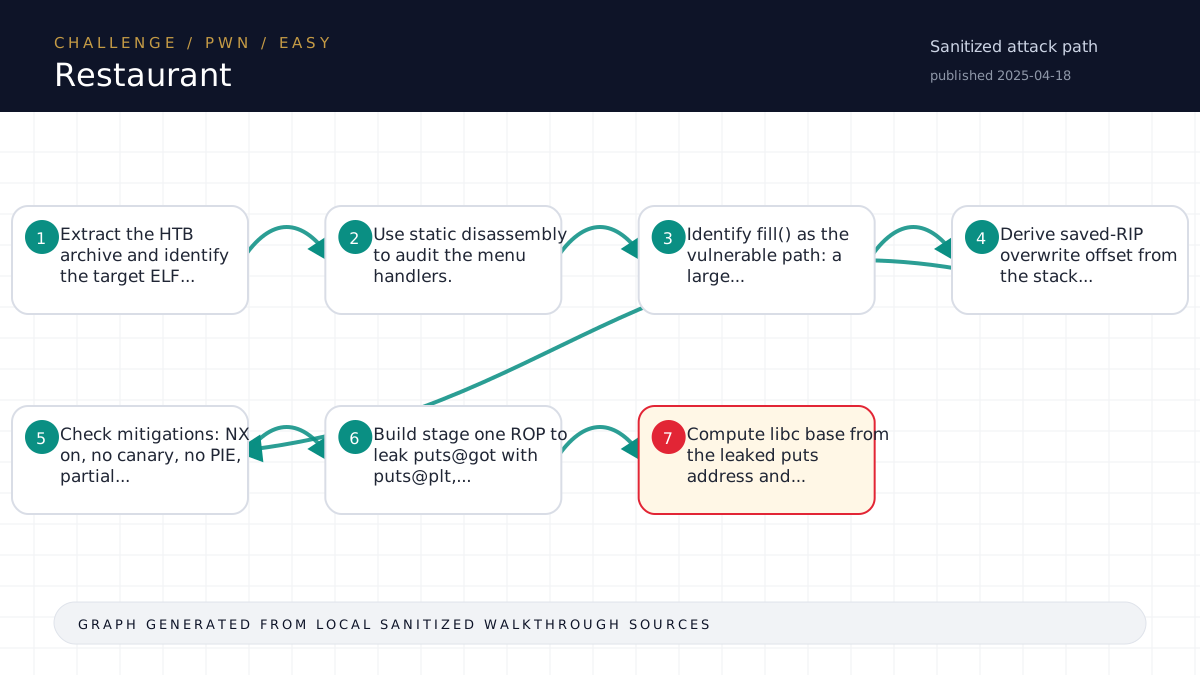
Walkthrough flow
Extract the HTB archive and identify the target ELF...
Use static disassembly to audit the menu handlers.
Identify fill() as the vulnerable path: a large...
Derive saved-RIP overwrite offset from the stack...
Check mitigations: NX on, no canary, no PIE, partial...
Source coverage
High source coverage
Status: complete. This article is generated from 6 sanitized Markdown sources and keeps raw flags, credentials, keys, cookies, and reusable secrets out of the rendered blog.
High confidence: the page is reconstructed from a primary walkthrough plus multiple supporting notes or evidence sources. Treat the chain as source-backed, while still checking the listed source files for sensitive values.
- Pwn/Restaurant/writeup.md
- htb-challenge/Pwn/Restaurant/notes.md
- htb-challenge/Pwn/Restaurant/memory-summary.md
- htb-challenge/Pwn/Restaurant/hypothesis-board.md
- HTB/_knowledge/exports/ctf-lightrag-latest-203412/documents/challenge__Pwn__Restaurant__memory-summary.md.2e28b074fa.md
- HTB/_knowledge/exports/ctf-lightrag-latest-203412/documents/challenge__Pwn__Restaurant__notes.md.e0fe44637a.md
Technical Walkthrough
Writeup
Challenge
- Name: Restaurant
- Category: Pwn
- Difficulty: Easy
- Mode: hybrid
Summary
Restaurant is a classic x86-64 ret2libc challenge. The fill() function reads 0x400 bytes into a 0x20 stack buffer, giving control of the saved return address at offset 40. The binary has NX enabled, no stack canary, no PIE, and partial RELRO. The final exploit leaks puts from the GOT to compute the provided libc base, returns to main, then uses libc gadgets to call execve('/bin/sh', 0, 0) and read the flag from the spawned shell.
Artifact Inventory
Reference analysis/artifact-inventory.json and summarize the relevant files or remote surface.
files/a12c733b-e972-4dfc-9e2c-c943c63fe653.zip: original HTB archive.analysis/extracted/pwn_restaurant/restaurant: target ELF.analysis/extracted/pwn_restaurant/libc.so.6: provided libc used for offsets.analysis/function-disasm.txt: disassembly ofsetup,fill,drink,main, and CSU.analysis/elf-mitigations.txt: static mitigation summary.analysis/gadgets.txt: binary gadget scan.analysis/multileak-check.txt: remote libc-match validation using several GOT leaks.solve/solve.py: final reproducible exploit.
Analysis
fileidentifiesrestaurantas a 64-bit Linux ELF, dynamically linked and not stripped.- Static mitigation parsing shows an executable type
EXECbinary with PIE disabled, NX enabled, GNU RELRO present but no BIND_NOW, and no stack canary symbol. fill()allocates0x20bytes on the stack and callsread(0, buffer, 0x400).- The saved RIP offset is therefore
0x20 + 8 = 40bytes. - The binary has a
pop rdi; retgadget at0x4010a3,puts@pltat0x400650,puts@gotat0x601fa8, andmainat0x400f68. - Stage one overflows
fill(), callsputs(puts@got), and returns tomain. - The leaked
putsaddress minus the provided libcputsoffset gives a page-aligned libc base. Multi-symbol leak checks confirmed the remote uses the provided libc. system()was tested but did not produce a usable command channel in this deployment.- The final stage uses libc gadgets for
pop rsi; retandpop rdx; ret, then callsexecve('/bin/sh', 0, 0). - The solver sends
catcommands to the spawned shell and captures the returned HTB-format flag.
Solve
Run:
python3 Pwn/Restaurant/solve/solve.py --host <TARGET> --port 30685The script performs the two-stage exploit, prints only the HTB-format flag, and writes a sanitized transcript when --transcript is supplied.
Flag
Raw flag is stored in loot/flag.txt and intentionally not reproduced here.
Lessons
- If
system('/bin/sh')does not yield interaction, verify libc matching first, then switch to directexecvewith explicit register-control gadgets. - Keep the receiver idle window long enough after spawning a shell; otherwise the exploit can close the socket after the immediate vulnerable-program output but before shell command output arrives.
- Multi-symbol GOT leaks are a cheap way to validate that a remote service is using the provided libc.
Source-Backed Dossier
The sections below are merged from companion Markdown notes for the same case. They are rendered after sanitization so the article stays precise without publishing raw flags, credentials, or target-specific secrets.
Notes
Scope
- Challenge: Restaurant
- Category: Pwn
- Difficulty: Easy
- Mode: hybrid
- Remote instance: none
- Start time: 2026-06-10T11:05:40Z
- Operator: harness
- State file:
challenge-state.json
Harness Status
- Current phase: see
challenge-state.json - Next allowed actions: see
next-action.json - Raw flags and sensitive material stay in
loot/only. Do not paste them here.
Artifact Inventory
| File | Size | SHA256 | Type | Notes |
|---|---|---|---|---|
files/a12c733b-e972-4dfc-9e2c-c943c63fe653.zip | 883854 | <hash redacted> | Zip archive data, at least v1.0 to extract, compression method=store | zip entries: 3 shown in artifact inventory JSON |
Evidence Ledger
| Time | Action | Output/File | Finding | Confidence | Next |
|---|---|---|---|---|---|
| 2026-06-10T11:05:40Z | harness init | challenge-state.json | Workspace initialized with deterministic state file | High | Inventory artifacts |
| 2026-06-10T11:06:02Z | artifact inventory | analysis/artifact-inventory.json | 1 artifact(s) inventoried | High | Build or update hypotheses |
| 2026-06-10T11:07:52Z | hypothesis recorded | hypothesis-board.md | Use fill() stack overflow for ret2libc: leak puts@got with puts@plt, return to main, compute libc base, then call system('/bin/sh') | Medium | Build local payload with 40-byte offset and one remote leak stage; parse leaked puts pointer and confirm it maps to provided libc alignment |
| 2026-06-10T11:08:11Z | research record | analysis/research/research-records.md | Research tagged MISSING | Medium | Validate against current evidence |
| 2026-06-10T11:08:47Z | local memory record | analysis/local-memory-records.md | Prior local notes reviewed as fallback/advisory context | Medium | Validate against current evidence |
| 2026-06-10T11:08:48Z | checkpoint recorded | analysis/checkpoint-analysis-20260610T110848910767Z-88239e3d.md | Checkpoint for ANALYSIS | High | Use checkpoint to drive next decision |
| 2026-06-10T11:09:23Z | source audit | analysis/source-audit.md | Source audit recorded | High | Gate before exploit |
| 2026-06-10T11:09:35Z | evaluator | analysis/evaluator-20260610T110935705108Z-c2edc4ea.md | Proceed | High | Run gate before exploit, then execute solve/solve.py through challenge_exec. |
| 2026-06-10T11:24:22Z | flag capture | loot/flag.txt | HTB-format flag captured; raw value kept in loot only | High | Write solution and run completion gate |
| 2026-06-10T11:25:45Z | flag capture | loot/flag.txt | HTB-format flag captured; raw value kept in loot only | High | Write solution and run completion gate |
| 2026-06-10T11:27:11Z | completion gate | challenge-state.json | Completion gate passed; state marked COMPLETE | High | Optional sanitized memory summary approval |
Key Findings
- The archive extracts to
restaurantand a matchinglibc.so.6. restaurantis an x86-64 Linux ELF, dynamically linked, not stripped, non-PIE.- Static mitigation check: NX enabled, no stack canary, partial RELRO, PIE disabled.
fill()allocates a0x20stack buffer and callsread(0, buffer, 0x400), giving a direct saved-RIP overwrite.- Saved RIP offset is
0x20 + 0x8 = 40bytes. - Useful binary addresses:
- pop rdi; ret: 0x4010a3
- plain ret: 0x40063e
- puts@plt: 0x400650
- puts@got: 0x601fa8
- main: 0x400f68
- Provided libc offsets:
- puts: 0x80aa0
- /bin/sh: 0x1b3e1a
- execve: 0xe4c00
- pop rsi; ret: libc offset 0x23eea
- pop rdx; ret: libc offset 0x130546
- Multi-symbol leak testing confirmed the remote libc matches the provided libc.
system()-based chains returned without useful shell output, so the final solver uses a directexecve('/bin/sh', 0, 0)chain.- Final exploit: choose menu option
1, overflowfill(), leakputs@gotviaputs@plt, return tomain, compute libc base, overflow again intoexecve('/bin/sh'), then readflag.txtthrough the spawned shell.
RAG / Advisory Memory
RAG output is advisory only. Record evaluated retrievals with:
scripts/challenge_harness.py rag-record <workspace> --query "..." --tag MATCHED|PARTIAL|MISSING|<secret redacted>|GENERIC --validation "..."Secrets/Flags
Raw flags and sensitive material stay in loot/ only. Use scripts/challenge_harness.py capture-flag to validate and record flag capture without printing the value.
Memory Summary
Metadata
- Platform: HackTheBox Challenges
- Category: Pwn
- Challenge: Restaurant
- Difficulty: Easy
- Source workspace:
<local workspace>
Validated Solve Chain
Concepts only. Do not include raw flags, reusable credentials, tokens, cookies, private keys, or live secrets.
- Extract the HTB archive and identify the target ELF plus provided libc.
- Use static disassembly to audit the menu handlers.
- Identify
fill()as the vulnerable path: a largeread()into a small stack buffer. - Derive saved-RIP overwrite offset from the stack frame.
- Check mitigations: NX on, no canary, no PIE, partial RELRO.
- Build stage one ROP to leak
puts@gotwithputs@plt, then return tomain. - Compute libc base from the leaked
putsaddress and validate the remote libc against the provided libc using additional GOT leaks. - Test
system()and close it as unreliable for this deployment. - Build final stage with libc gadgets to call
execve('/bin/sh', 0, 0). - Send shell commands to read the flag and capture through the harness.
Reusable Lessons
- Direct
execve('/bin/sh', 0, 0)can be more reliable thansystem('/bin/sh')whensystem()returns without useful command output. - Verify remote libc with more than one symbol when a ret2libc chain behaves unexpectedly.
- Receiver idle windows matter for shell-based pwn exploits; do not close the socket immediately after the vulnerable program emits its final line.
- Sanitized transcripts should redact flag-shaped output outside
loot/.
Dead Ends
- RAG/private memory did not contain a matching Restaurant solve pattern.
system()-based chains were tested but did not yield a usable shell or command output.
Tool Quirks
- Docker was installed but the daemon was unavailable, so local Linux execution/debugging was not used.
- Local pwntools/gdb/checksec were unavailable; the solve used static ELF parsing,
objdump,nm, Python sockets, and remote validation. - The vulnerable
printf("Enjoy your %s")prints a few non-null ROP bytes before the GOT leak, so leak parsing must skip the printed payload prefix.
Evidence Paths
analysis/function-disasm.txtanalysis/elf-mitigations.txtanalysis/gadgets.txtanalysis/libc-symbols-expanded.txtanalysis/multileak-check.txtanalysis/execve-shell-debug-rerun.txtsolve/solve.pyloot/flag.txt
Ingestion Decision
- Proposed for LightRAG: yes
- Requires user approval before ingestion: yes
Hypothesis Board
Keep no more than 3 active hypotheses on Easy/Medium and 5 on Hard unless the user explicitly asks for breadth.
| Rank | Path | Evidence | Missing Proof | Cheapest Validation | Confidence | Status |
|---|---|---|---|---|---|---|
| 1 | Use fill() stack overflow for ret2libc: leak puts@got with puts@plt, return to main, compute libc base, then call system('/bin/sh') | fill reads 0x400 bytes into a 0x20 stack buffer; NX enabled, no canary, no PIE, partial RELRO; provided libc has puts/system/binsh offsets | Build local payload with 40-byte offset and one remote leak stage; parse leaked puts pointer and confirm it maps to provided libc alignment | Medium | Active |
Closed Branches
| Branch | Evidence Tested | Failure Output | Reason Closed | Revisit Condition |
|---|
Memory Summary
approval_required: true
Sanitized Memory Summary
Metadata
- Platform: HackTheBox Challenges
- Category: Pwn
- Challenge: Restaurant
- Difficulty: Easy
- Source workspace:
<local workspace>
Validated Solve Chain
Concepts only. Do not include raw flags, reusable credentials, tokens, cookies, private keys, or live secrets.
- Extract the HTB archive and identify the target ELF plus provided libc.
- Use static disassembly to audit the menu handlers.
- Identify
fill()as the vulnerable path: a largeread()into a small stack buffer. - Derive saved-RIP overwrite offset from the stack frame.
- Check mitigations: NX on, no canary, no PIE, partial RELRO.
- Build stage one ROP to leak
puts@gotwithputs@plt, then return tomain. - Compute libc base from the leaked
putsaddress and validate the remote libc against the provided libc using additional GOT leaks. - Test
system()and close it as unreliable for this deployment. - Build final stage with libc gadgets to call
execve('/bin/sh', 0, 0). - Send shell commands to read the flag and capture through the harness.
Reusable Lessons
- Direct
execve('/bin/sh', 0, 0)can be more reliable thansystem('/bin/sh')whensystem()returns without useful command output. - Verify remote libc with more than one symbol when a ret2libc chain behaves unexpectedly.
- Receiver idle windows matter for shell-based pwn exploits; do not close the socket immediately after the vulnerable program emits its final line.
- Sanitized transcripts should redact flag-shaped output outside
loot/.
Dead Ends
- RAG/private memory did not contain a matching Restaurant solve pattern.
system()-based chains were tested but did not yield a usable shell or command output.
Tool Quirks
- Docker was installed but the daemon was unavailable, so local Linux execution/debugging was not used.
- Local pwntools/gdb/checksec were unavailable; the solve used static ELF parsing,
objdump,nm, Python sockets, and remote validation. - The vulnerable
printf("Enjoy your %s")prints a few non-null ROP bytes before the GOT leak, so leak parsing must skip the printed payload prefix.
Evidence Paths
analysis/function-disasm.txtanalysis/elf-mitigations.txtanalysis/gadgets.txtanalysis/libc-symbols-expanded.txtanalysis/multileak-check.txtanalysis/execve-shell-debug-rerun.txtsolve/solve.pyloot/flag.txt
Ingestion Decision
- Proposed for LightRAG: yes
- Requires user approval before ingestion: yes
Notes
Notes
Scope
- Challenge: Restaurant
- Category: Pwn
- Difficulty: Easy
- Mode: hybrid
- Remote instance: none
- Start time: 2026-06-10T11:05:40Z
- Operator: harness
- State file:
challenge-state.json
Harness Status
- Current phase: see
challenge-state.json - Next allowed actions: see
next-action.json - Raw flags and sensitive material stay in
loot/only. Do not paste them here.
Artifact Inventory
| File | Size | SHA256 | Type | Notes |
|---|---|---|---|---|
files/a12c733b-e972-4dfc-9e2c-c943c63fe653.zip | 883854 | <hash redacted> | Zip archive data, at least v1.0 to extract, compression method=store | zip entries: 3 shown in artifact inventory JSON |
Evidence Ledger
| Time | Action | Output/File | Finding | Confidence | Next |
|---|---|---|---|---|---|
| 2026-06-10T11:05:40Z | harness init | challenge-state.json | Workspace initialized with deterministic state file | High | Inventory artifacts |
| 2026-06-10T11:06:02Z | artifact inventory | analysis/artifact-inventory.json | 1 artifact(s) inventoried | High | Build or update hypotheses |
| 2026-06-10T11:07:52Z | hypothesis recorded | hypothesis-board.md | Use fill() stack overflow for ret2libc: leak puts@got with puts@plt, return to main, compute libc base, then call system('/bin/sh') | Medium | Build local payload with 40-byte offset and one remote leak stage; parse leaked puts pointer and confirm it maps to provided libc alignment |
| 2026-06-10T11:08:11Z | research record | analysis/research/research-records.md | Research tagged MISSING | Medium | Validate against current evidence |
| 2026-06-10T11:08:47Z | local memory record | analysis/local-memory-records.md | Prior local notes reviewed as fallback/advisory context | Medium | Validate against current evidence |
| 2026-06-10T11:08:48Z | checkpoint recorded | analysis/checkpoint-analysis-20260610T110848910767Z-88239e3d.md | Checkpoint for ANALYSIS | High | Use checkpoint to drive next decision |
| 2026-06-10T11:09:23Z | source audit | analysis/source-audit.md | Source audit recorded | High | Gate before exploit |
| 2026-06-10T11:09:35Z | evaluator | analysis/evaluator-20260610T110935705108Z-c2edc4ea.md | Proceed | High | Run gate before exploit, then execute solve/solve.py through challenge_exec. |
| 2026-06-10T11: <REDACTED> | |||||
| 2026-06-10T11: <REDACTED> | |||||
| 2026-06-10T11:27:11Z | completion gate | challenge-state.json | Completion gate passed; state marked COMPLETE | High | Optional sanitized memory summary approval |
Key Findings
- The archive extracts to
restaurantand a matchinglibc.so.6. restaurantis an x86-64 Linux ELF, dynamically linked, not stripped, non-PIE.- Static mitigation check: NX enabled, no stack canary, partial RELRO, PIE disabled.
fill()allocates a0x20stack buffer and callsread(0, buffer, 0x400), giving a direct saved-RIP overwrite.- Saved RIP offset is
0x20 + 0x8 = 40bytes. - Useful binary addresses:
- pop rdi; ret: 0x4010a3
- plain ret: 0x40063e
- puts@plt: 0x400650
- puts@got: 0x601fa8
- main: 0x400f68
- Provided libc offsets:
- puts: 0x80aa0
- /bin/sh: 0x1b3e1a
- execve: 0xe4c00
- pop rsi; ret: libc offset 0x23eea
- pop rdx; ret: libc offset 0x130546
- Multi-symbol leak testing confirmed the remote libc matches the provided libc.
system()-based chains returned without useful shell output, so the final solver uses a directexecve('/bin/sh', 0, 0)chain.- Final exploit: <REDACTED>, overflow
fill(), leakputs@gotviaputs@plt, return tomain, compute libc base, overflow again intoexecve('/bin/sh'), then readflag.txtthrough the spawned shell.
RAG / Advisory Memory
RAG output is advisory only. Record evaluated retrievals with:
scripts/challenge_harness.py rag-record <workspace> --query "..." --tag MATCHED|PARTIAL|MISSING|<secret redacted>|GENERIC --validation "..."Secrets/Flags
Raw flags and sensitive material stay in loot/ only. Use scripts/challenge_harness.py capture-flag to validate and record flag capture without printing the value.
Technical analogy
How to remember this solve
Think of the challenge as a small system with one rule that matters more than the rest. The solve is finding that rule, validating it, and using it carefully enough to reach the final proof.
For Restaurant, keep the mental model simple: identify the trusted assumption, prove it with the smallest safe test, then automate or repeat only the part that directly leads to the flag.