
Lucky Dice
Lucky Dice is a sanitized challenge note from the local HTB archive, organized for quick review by category, difficulty, evidence flow, and reusable operator
Scenario
Lucky Dice attack path
Lucky Dice is a sanitized challenge note from the local HTB archive, organized for quick review by category, difficulty, evidence flow, and reusable operator
Objective
Challenge walkthrough focused on Misc evidence, validation, and reusable operator lessons.
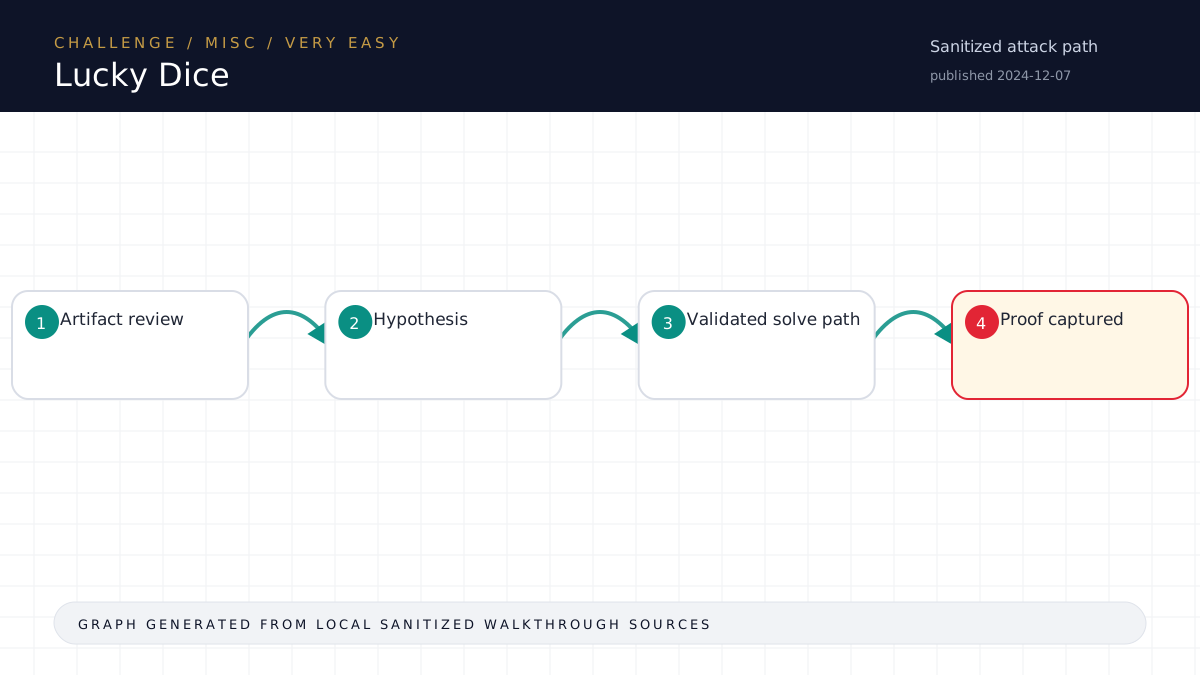
Walkthrough flow
Artifact review
Hypothesis
Validated solve path
Proof captured
Source coverage
Moderate source coverage
Status: partial. This article is generated from 4 sanitized Markdown sources and keeps raw flags, credentials, keys, cookies, and reusable secrets out of the rendered blog.
Moderate confidence: the page is useful for review, but it should be treated as partial because the available source material is thinner or less narrative-complete.
- Misc/LuckyDice/writeup.md
- htb-challenge/Misc/LuckyDice/notes.md
- htb-challenge/Misc/LuckyDice/memory-summary.md
- htb-challenge/Misc/LuckyDice/hypothesis-board.md
Technical Walkthrough
Lucky Dice - Writeup
Challenge Info
- Name: Lucky Dice
- Category: Misc
- Difficulty: Very Easy
- Flag:
<flag stored in loot/flag.txt>
Approach
Triage
Single Python file (challenge.py) — a dice game server that requires correct answers for 100 rounds within 0.3 seconds each.
Analysis
- 8-13 players per game (random)
- Each round:
round * 2 + 2dice per player - Winner = highest sum; ties broken by highest player number
- Timeout: 0.3 seconds — impossible manually, requires automation
Solve
# Parse "Player X: d1 d2 d3 ..." lines with regex
players = re.findall(r'Player (\d+): ([\d ]+)', data)

# Find winner: highest sum, highest player number on tie
max_sum = -1
winner = -1
for player_num, dice_str in players:
    s = sum(int(d) for d in dice_str.split())
    pn = int(player_num)
    if s > max_sum or (s == max_sum and pn > winner):
        max_sum = s
        winner = pn
Full script at solve/solve.py — plain socket implementation (no pwntools dependency).
Key Insight
Pure automation challenge. The logic is trivial (sum dice, find max), but the 0.3-second timeout forces scripting. No crypto, no exploitation — just fast I/O parsing.
Time: ~3 minutes
Source-Backed Dossier
The sections below are merged from companion Markdown notes for the same case. They are rendered after sanitization so the article stays precise without publishing raw flags, credentials, or target-specific secrets.
Notes
Scope
- Challenge: Lucky Dice
- Category: Misc
- Difficulty: Very Easy
- Target: <TARGET>:31092
- Started: 2026-05-07
Evidence Ledger
| Timestamp | Action | Finding | Next |
|---|---|---|---|
| 00:00 | Read challenge.py | 100-round dice game, 0.3s timeout per answer, need to identify winner each round | Write automation |
| 00:02 | Write solve.py | Socket-based automation, parse dice sums, send winner | Run against remote |
| 00:03 | Run solve.py | All 100 rounds correct, flag received | Done |
Solution
- Game rolls dice for 8-13 players across 100 rounds
- Must identify the round winner (highest dice sum) within 0.3 seconds
- Tie-breaker: highest-numbered player wins
- Automated with Python sockets + regex parsing
| 2026-05-27T23:35:17Z | backfill | challenge-state.json | Legacy workspace backfilled with deterministic state | High | Validate before further work |
Memory Summary
Metadata
- Platform: HackTheBox Challenges
- Category:
- Challenge:
- Difficulty:
- Source workspace:
Validated Solve Chain
Concepts only. Do not include raw flags, reusable credentials, tokens, cookies, private keys, or live secrets.
1.
Reusable Lessons
-
Dead Ends
-
Tool Quirks
-
Evidence Paths
-
Ingestion Decision
- Proposed for LightRAG: yes/no
- Requires user approval before ingestion: yes
Hypothesis Board
| Rank | Path | Evidence | Missing Proof | Cheapest Validation | Confidence | Status |
|---|
Closed Branches
| Branch | Evidence Tested | Failure Output | Reason Closed | Revisit Condition |
|---|
Technical analogy
How to remember this solve
Think of the challenge like a timed puzzle booth. If the task is too fast or repetitive for a person, the intended move is usually to write a small helper that performs the simple action perfectly.
For Lucky Dice, keep the mental model simple: identify the trusted assumption, prove it with the smallest safe test, then automate or repeat only the part that directly leads to the flag.