
Ether Tag
Ether Tag is a sanitized challenge note from the local HTB archive, organized for quick review by category, difficulty, evidence flow, and reusable operator
Scenario
Ether Tag attack path
Ether Tag is a sanitized challenge note from the local HTB archive, organized for quick review by category, difficulty, evidence flow, and reusable operator
Objective
Challenge walkthrough focused on ICS evidence, validation, and reusable operator lessons.
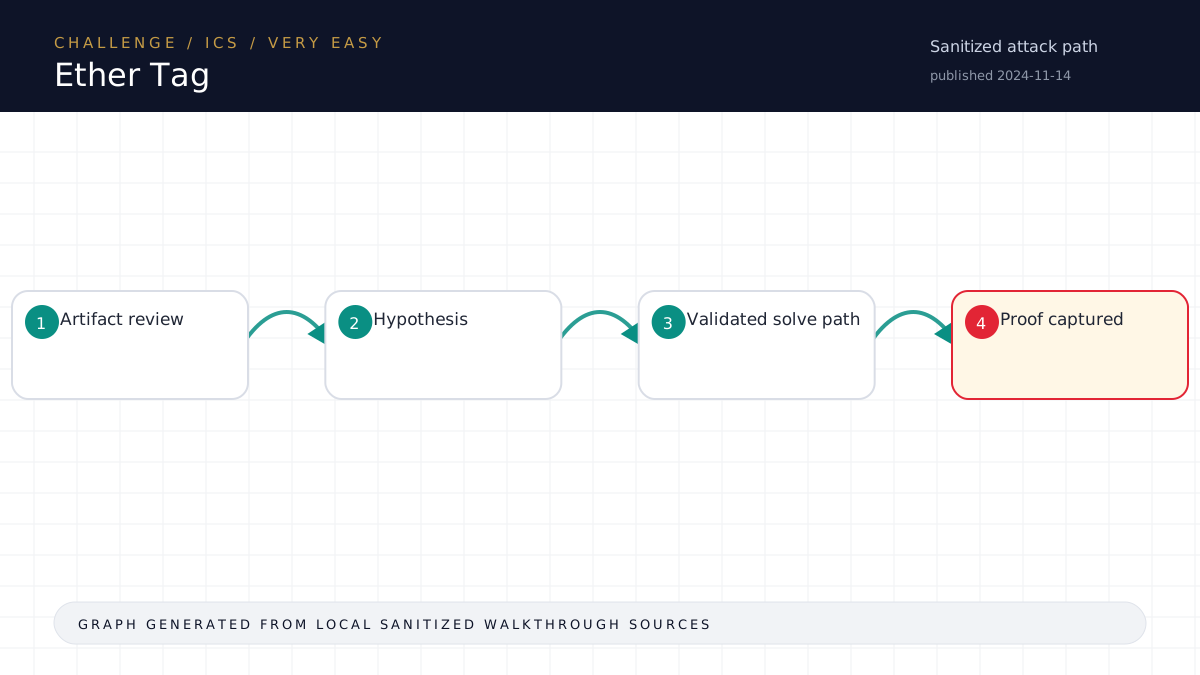
Walkthrough flow
Artifact review
Hypothesis
Validated solve path
Proof captured
Source coverage
Moderate source coverage
Status: partial. This article is generated from 4 sanitized Markdown sources and keeps raw flags, credentials, keys, cookies, and reusable secrets out of the rendered blog.
Moderate confidence: the page is useful for review, but it should be treated as partial because the available source material is thinner or less narrative-complete.
- ICS/EtherTag/writeup.md
- htb-challenge/ICS/EtherTag/notes.md
- htb-challenge/ICS/EtherTag/memory-summary.md
- htb-challenge/ICS/EtherTag/hypothesis-board.md
Technical Walkthrough
Ether Tag - Writeup
Challenge Info
- Name: Ether Tag
- Category: ICS
- Difficulty: Very Easy
- Flag:
<flag stored in loot/flag.txt>
Approach
Triage
Target exposes EtherNet/IP (CIP protocol) on a non-standard port. Not HTTP — raw industrial protocol.
Analysis
pycomm3LogixDriver connects but fails tag enumeration (simplified CIP implementation)cpppoclient successfully reads tags via the EtherNet/IP pipeline- Single element read returns
[72](ASCII 'H') — flag stored as SINT array
Solve
from cpppo.server.enip import client

with client.connector(host='TARGET', port=PORT, timeout=10) as conn:
    operations = client.parse_operations(['FLAG[0-99]'])
    for idx, dsc, op, rpy, sts, val in conn.pipeline(operations=operations, timeout=10):
        if val is not None:
            flag = ''.join(chr(v) for v in val if v != 0)
            print(flag)
Key Insight
The flag is stored as an array of SINT (8-bit integer) values in a CIP tag named "FLAG". Reading FLAG alone returns only the first byte. Reading FLAG[0-99] returns the full array which decodes to the flag string.
Time: ~3 minutes
Source-Backed Dossier
The sections below are merged from companion Markdown notes for the same case. They are rendered after sanitization so the article stays precise without publishing raw flags, credentials, or target-specific secrets.
Notes
Scope
- Challenge: Ether Tag
- Category: ICS
- Difficulty: Very Easy
- Target: <TARGET>:32430 (EtherNet/IP)
- Started: 2026-05-07
Evidence Ledger
| Timestamp | Action | Finding | Next |
|---|---|---|---|
| 00:00 | nc -z port check | Port 32430 open, not HTTP | EtherNet/IP protocol |
| 00:01 | pycomm3 LogixDriver | Connected but tag list enum fails, read returns None | Try cpppo |
| 00:02 | cpppo parse_operations FLAG | Returns [72] (ASCII 'H') — single element | Read array |
| 00:03 | cpppo FLAG[0-99] | Full flag: <flag stored in loot/flag.txt> | Done |
Solution
- EtherNet/IP controller with a CIP tag named "FLAG"
- Tag stores flag as SINT array (one ASCII byte per element)
- Read with
cpppolibrary:client.parse_operations(['FLAG[0-99]'])over pipeline - Convert integer array to ASCII string
Memory Summary
Metadata
- Platform: HackTheBox Challenges
- Category:
- Challenge:
- Difficulty:
- Source workspace:
Validated Solve Chain
Concepts only. Do not include raw flags, reusable credentials, tokens, cookies, private keys, or live secrets.
1.
Reusable Lessons
-
Dead Ends
-
Tool Quirks
-
Evidence Paths
-
Ingestion Decision
- Proposed for LightRAG: yes/no
- Requires user approval before ingestion: yes
Hypothesis Board
| Rank | Path | Evidence | Missing Proof | Cheapest Validation | Confidence | Status |
|---|
Closed Branches
| Branch | Evidence Tested | Failure Output | Reason Closed | Revisit Condition |
|---|
Technical analogy
How to remember this solve
Think of the industrial system like a control-room checklist. You map the inputs, outputs, and assumptions, then find the one control path that accepts a state it should have rejected.
For Ether Tag, keep the mental model simple: identify the trusted assumption, prove it with the smallest safe test, then automate or repeat only the part that directly leads to the flag.