
Rhome
Rhome is a sanitized challenge note from the local HTB archive, organized for quick review by category, difficulty, evidence flow, and reusable operator
Scenario
Rhome attack path
Rhome is a sanitized challenge note from the local HTB archive, organized for quick review by category, difficulty, evidence flow, and reusable operator
Objective
Challenge walkthrough focused on Crypto evidence, validation, and reusable operator lessons.
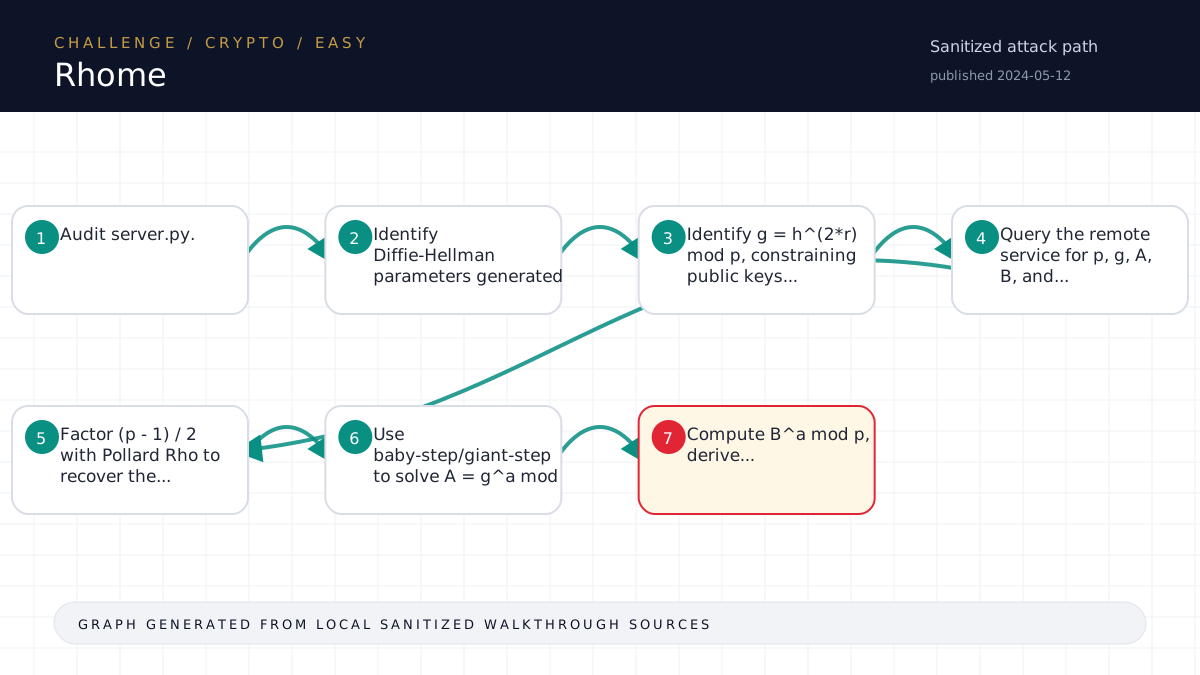
Walkthrough flow
Audit server.py.
Identify Diffie-Hellman parameters generated as p =...
Identify g = h^(2*r) mod p, constraining public keys...
Query the remote service for p, g, A, B, and...
Factor (p - 1) / 2 with Pollard Rho to recover the...
Source coverage
High source coverage
Status: complete. This article is generated from 6 sanitized Markdown sources and keeps raw flags, credentials, keys, cookies, and reusable secrets out of the rendered blog.
High confidence: the page is reconstructed from a primary walkthrough plus multiple supporting notes or evidence sources. Treat the chain as source-backed, while still checking the listed source files for sensitive values.
- Crypto/Rhome/writeup.md
- htb-challenge/Crypto/Rhome/notes.md
- htb-challenge/Crypto/Rhome/memory-summary.md
- htb-challenge/Crypto/Rhome/hypothesis-board.md
- HTB/_knowledge/exports/ctf-lightrag-latest-203412/documents/challenge__Crypto__Rhome__memory-summary.md.7fe27cfb46.md
- HTB/_knowledge/exports/ctf-lightrag-latest-203412/documents/challenge__Crypto__Rhome__notes.md.72511f680b.md
Technical Walkthrough
Writeup
Challenge
- Name: Rhome
- Category: Crypto
- Difficulty: Easy
- Mode: hybrid
Summary
The service implements Diffie-Hellman, but it deliberately places the generator in a tiny subgroup. The modulus is generated as p = 2qr + 1 with q only 42 bits, and g = h^(2*r) mod p, so the public keys A and B live in the subgroup of order q. Factoring p-1 recovers q, and baby-step/giant-step recovers the exponent modulo q, which is enough to derive the shared secret and decrypt the AES-ECB flag ciphertext.
Artifact Inventory
- Original archive:
files/a12c7355-a35e-4808-a203-839a95532bec.zip - Extracted source:
files/extracted/crypto_rhome/server.py - Remote service:
<TARGET>:32375 - Key evidence:
- analysis/source-audit.md
- analysis/solve-run-summary.json
- analysis/remote-transcript-redacted.txt
Analysis
server.py creates parameters as:
self.q = getPrime(42)
self.p = (2 * self.q * self.r) + 1
self.g = pow(self.h, 2 * self.r, self.p)
Since p - 1 = 2qr, exponentiating h by 2*r removes the large cofactor and leaves g in a subgroup whose order divides the 42-bit prime q. The service exposes:
p
g
A = g^a mod p
B = g^b mod p
It encrypts the flag with:
key = sha256(long_to_bytes(ss)).digest()[:16]
AES.new(key, <secret redacted>)
The attack is:
- Factor
(p - 1) / 2to recover the smallq. - Solve
A = g^a mod pin the order-qsubgroup with baby-step/giant-step. - Compute
ss = B^a mod p. - Derive the AES key and decrypt the ciphertext.
RAG did not return useful Rhome-specific guidance, so the solve used the current source and remote transcript as evidence; see analysis/rag-records.md.
Solve
The reproducible solver is solve/solve.py.
It performs:
- Connects to the remote service and requests parameters plus encrypted flag.
- Uses Pollard Rho to recover the 42-bit subgroup factor
qfromp-1. - Uses baby-step/giant-step to recover
a mod q. - Computes the shared secret as
B^a mod p. - Decrypts the AES-ECB ciphertext.
- Writes the raw flag candidate to
loot/flag-candidate.txt.
The successful run is summarized in analysis/solve-run-summary.json. The harness captured the result into loot/flag.txt.
Flag
Raw flag is stored in loot/flag.txt and intentionally not reproduced here.
Lessons
- A large prime modulus does not help if the generator is constrained to a small subgroup.
- In Diffie-Hellman, validate the generator order and public-key subgroup membership.
- A 42-bit discrete log is practical with baby-step/giant-step.
- Keep raw decrypted flags in
loot/; store only summaries and hashes inanalysis/.
Source-Backed Dossier
The sections below are merged from companion Markdown notes for the same case. They are rendered after sanitization so the article stays precise without publishing raw flags, credentials, or target-specific secrets.
Notes
Scope
- Challenge: Rhome
- Category: Crypto
- Difficulty: Easy
- Mode: hybrid
- Remote instance: <TARGET>:32375
- Start time: 2026-06-09T11:25:38Z
- Operator: harness
- State file:
challenge-state.json
Harness Status
- Current phase: see
challenge-state.json - Next allowed actions: see
next-action.json - Raw flags and sensitive material stay in
loot/only. Do not paste them here.
Artifact Inventory
| File | Size | SHA256 | Type | Notes |
|---|---|---|---|---|
files/a12c7355-a35e-4808-a203-839a95532bec.zip | 1044 | <hash redacted> | Zip archive data, at least v1.0 to extract, compression method=store | zip entries: 2 shown in artifact inventory JSON |
files/extracted/crypto_rhome/server.py | 1753 | <hash redacted> | Python script text executable, ASCII text |
Evidence Ledger
| Time | Action | Output/File | Finding | Confidence | Next |
|---|---|---|---|---|---|
| 2026-06-09T11:25:38Z | harness init | challenge-state.json | Workspace initialized with deterministic state file | High | Inventory artifacts |
| 2026-06-09T11:25:51Z | artifact inventory | analysis/artifact-inventory.json | 2 artifact(s) inventoried | High | Build or update hypotheses |
| 2026-06-09T11:26:33Z | hypothesis recorded | hypothesis-board.md | Recover the Diffie-Hellman shared secret by exploiting the deliberately small 42-bit subgroup order, then decrypt the AES-ECB ciphertext returned by the remote flag option. | Medium | Factor p-1 to recover the 42-bit q, solve discrete log A = g^a in subgroup order q with BSGS, derive ss = B^a mod p, then decrypt one remote ciphertext. |
| 2026-06-09T11:26:33Z | source audit | analysis/source-audit.md | Source audit recorded | High | Gate before exploit |
| 2026-06-09T11:26:33Z | checkpoint recorded | analysis/checkpoint-analysis-20260609T112633261307Z-9d7cc7ea.md | Checkpoint for ANALYSIS | High | Use checkpoint to drive next decision |
| 2026-06-09T11:26:51Z | RAG query | analysis/rag/rag-query-20260609T112642524135Z-6c969f14.txt | RAG helper exited 0; output saved | Medium | Record retrieval tag and validation |
| 2026-06-09T11:27:17Z | RAG record | analysis/rag-records.md | Retrieved memory tagged MISSING | Medium | Validate or reject with live evidence |
| 2026-06-09T11:27:48Z | local memory record | analysis/local-memory-records.md | Prior local notes reviewed as fallback/advisory context | Medium | Validate against current evidence |
| 2026-06-09T11:28:54Z | evaluator | analysis/evaluator-20260609T112854618618Z-e9b9a79b.md | Proceed | High | Run exploit gate and execute solve/solve.py through challenge_exec. |
| 2026-06-09T11:29:23Z | flag capture | loot/flag.txt | HTB-format flag captured; raw value kept in loot only | High | Write solution and run completion gate |
| 2026-06-09T11:30:24Z | completion gate | challenge-state.json | Completion gate passed; state marked COMPLETE | High | Optional sanitized memory summary approval |
Key Findings
server.pyexposesp,g,A, andBthrough menu option 1.- Parameters are generated as
p = 2qr + 1whereqis only a 42-bit prime. g = h^(2*r) mod p, so public keys live in the small subgroup whose order dividesq.- The shared secret can be recovered by factoring
p-1to recoverq, solvingA = g^a mod pin that subgroup, then computingB^a mod p. - The flag ciphertext is AES-ECB with key
SHA256(long_to_bytes(shared_secret))[:16]. - RAG did not return a useful Rhome-specific match; use source audit and live remote parameters as evidence.
RAG / Advisory Memory
RAG output is advisory only. Record evaluated retrievals with:
scripts/challenge_harness.py rag-record <workspace> --query "..." --tag MATCHED|PARTIAL|MISSING|<secret redacted>|GENERIC --validation "..."Secrets/Flags
Raw flags and sensitive material stay in loot/ only. Use scripts/challenge_harness.py capture-flag to validate and record flag capture without printing the value.
Memory Summary
Metadata
- Platform: HackTheBox Challenges
- Category: Crypto
- Challenge: Rhome
- Difficulty: Easy
- Source workspace:
<local workspace>
Validated Solve Chain
Concepts only. Do not include raw flags, reusable credentials, tokens, cookies, private keys, or live secrets.
- Audit
server.py. - Identify Diffie-Hellman parameters generated as
p = 2qr + 1withqonly 42 bits. - Identify
g = h^(2*r) mod p, constraining public keys to the small subgroup of orderq. - Query the remote service for
p,g,A,B, and ciphertext. - Factor
(p - 1) / 2with Pollard Rho to recover the 42-bitq. - Use baby-step/giant-step to solve
A = g^a mod pmoduloq. - Compute
B^a mod p, deriveSHA256(long_to_bytes(shared_secret))[:16], and decrypt AES-ECB. - Store the raw flag under
loot/only.
Reusable Lessons
- Small-subgroup Diffie-Hellman can make an otherwise large modulus breakable.
- If
p - 1has a small factor andgis projected into that subgroup, BSGS over the small order is enough. - Pollard Rho plus BSGS is practical for a 42-bit subgroup without Sage/SymPy.
- Store discrete-log exponents and shared secrets as hashes in analysis artifacts, not raw values.
Dead Ends
- RAG returned no useful Rhome-specific or matching small-subgroup DH memory. The solve used current source and live remote evidence.
Tool Quirks
- Local
sympy,z3,sage, andpwntoolswere unavailable. Pure Python, sockets, and PyCryptodome were sufficient. - Baby-step/giant-step for a 42-bit subgroup uses a few million table entries but completed quickly enough locally.
Evidence Paths
analysis/source-audit.mdanalysis/checkpoint-analysis-20260609T112633261307Z-9d7cc7ea.mdanalysis/rag/rag-query-20260609T112642524135Z-6c969f14.txtanalysis/rag-records.mdanalysis/evaluator-20260609T112854618618Z-e9b9a79b.mdanalysis/solve-run-summary.jsonsolve/solve.pyloot/flag.txt
Ingestion Decision
- Proposed for LightRAG: yes
- Requires user approval before ingestion: yes
Hypothesis Board
Keep no more than 3 active hypotheses on Easy/Medium and 5 on Hard unless the user explicitly asks for breadth.
| Rank | Path | Evidence | Missing Proof | Cheapest Validation | Confidence | Status |
|---|---|---|---|---|---|---|
| 1 | Recover the Diffie-Hellman shared secret by exploiting the deliberately small 42-bit subgroup order, then decrypt the AES-ECB ciphertext returned by the remote flag option. | server.py constructs p = 2qr + 1 with q = getPrime(42), sets g = h^(2*r) mod p, and exposes p,g,A,B plus encrypted FLAG under SHA256(shared_secret)[:16]. | Factor p-1 to recover the 42-bit q, solve discrete log A = g^a in subgroup order q with BSGS, derive ss = B^a mod p, then decrypt one remote ciphertext. | Medium | Active |
Closed Branches
| Branch | Evidence Tested | Failure Output | Reason Closed | Revisit Condition |
|---|
Memory Summary
approval_required: true
Sanitized Memory Summary
Metadata
- Platform: HackTheBox Challenges
- Category: Crypto
- Challenge: Rhome
- Difficulty: Easy
- Source workspace:
<local workspace>
Validated Solve Chain
Concepts only. Do not include raw flags, reusable credentials, tokens, cookies, private keys, or live secrets.
- Audit
server.py. - Identify Diffie-Hellman parameters generated as
p = 2qr + 1withqonly 42 bits. - Identify
g = h^(2*r) mod p, constraining public keys to the small subgroup of orderq. - Query the remote service for
p,g,A,B, and ciphertext. - Factor
(p - 1) / 2with Pollard Rho to recover the 42-bitq. - Use baby-step/giant-step to solve
A = g^a mod pmoduloq. - Compute
B^a mod p, deriveSHA256(long_to_bytes(shared_secret))[:16], and decrypt AES-ECB. - Store the raw flag under
loot/only.
Reusable Lessons
- Small-subgroup Diffie-Hellman can make an otherwise large modulus breakable.
- If
p - 1has a small factor andgis projected into that subgroup, BSGS over the small order is enough. - Pollard Rho plus BSGS is practical for a 42-bit subgroup without Sage/SymPy.
- Store discrete-log exponents and shared secrets as hashes in analysis artifacts, not raw values.
Dead Ends
- RAG returned no useful Rhome-specific or matching small-subgroup DH memory. The solve used current source and live remote evidence.
Tool Quirks
- Local
sympy,z3,sage, andpwntoolswere unavailable. Pure Python, sockets, and PyCryptodome were sufficient. - Baby-step/giant-step for a 42-bit subgroup uses a few million table entries but completed quickly enough locally.
Evidence Paths
analysis/source-audit.mdanalysis/checkpoint-analysis-20260609T112633261307Z-9d7cc7ea.mdanalysis/rag/rag-query-20260609T112642524135Z-6c969f14.txtanalysis/rag-records.mdanalysis/evaluator-20260609T112854618618Z-e9b9a79b.mdanalysis/solve-run-summary.jsonsolve/solve.pyloot/flag.txt
Ingestion Decision
- Proposed for LightRAG: yes
- Requires user approval before ingestion: yes
Notes
Notes
Scope
- Challenge: Rhome
- Category: Crypto
- Difficulty: Easy
- Mode: hybrid
- Remote instance: <TARGET>:32375
- Start time: 2026-06-09T11:25:38Z
- Operator: harness
- State file:
challenge-state.json
Harness Status
- Current phase: see
challenge-state.json - Next allowed actions: see
next-action.json - Raw flags and sensitive material stay in
loot/only. Do not paste them here.
Artifact Inventory
| File | Size | SHA256 | Type | Notes |
|---|---|---|---|---|
files/a12c7355-a35e-4808-a203-839a95532bec.zip | 1044 | <hash redacted> | Zip archive data, at least v1.0 to extract, compression method=store | zip entries: 2 shown in artifact inventory JSON |
files/extracted/crypto_rhome/server.py | 1753 | <hash redacted> | Python script text executable, ASCII text |
Evidence Ledger
| Time | Action | Output/File | Finding | Confidence | Next |
|---|---|---|---|---|---|
| 2026-06-09T11:25:38Z | harness init | challenge-state.json | Workspace initialized with deterministic state file | High | Inventory artifacts |
| 2026-06-09T11:25:51Z | artifact inventory | analysis/artifact-inventory.json | 2 artifact(s) inventoried | High | Build or update hypotheses |
| 2026-06-09T11: <REDACTED>, then decrypt the AES-ECB ciphertext returned by the remote flag option. | Medium | Factor p-1 to recover the 42-bit q, solve discrete log A = <REDACTED>, derive ss = <REDACTED>, then decrypt one remote ciphertext. | |||
| 2026-06-09T11:26:33Z | source audit | analysis/source-audit.md | Source audit recorded | High | Gate before exploit |
| 2026-06-09T11:26:33Z | checkpoint recorded | analysis/checkpoint-analysis-20260609T112633261307Z-9d7cc7ea.md | Checkpoint for ANALYSIS | High | Use checkpoint to drive next decision |
| 2026-06-09T11:26:51Z | RAG query | analysis/rag/rag-query-20260609T112642524135Z-6c969f14.txt | RAG helper exited 0; output saved | Medium | Record retrieval tag and validation |
| 2026-06-09T11:27:17Z | RAG record | analysis/rag-records.md | Retrieved memory tagged MISSING | Medium | Validate or reject with live evidence |
| 2026-06-09T11:27:48Z | local memory record | analysis/local-memory-records.md | Prior local notes reviewed as fallback/advisory context | Medium | Validate against current evidence |
| 2026-06-09T11:28:54Z | evaluator | analysis/evaluator-20260609T112854618618Z-e9b9a79b.md | Proceed | High | Run exploit gate and execute solve/solve.py through challenge_exec. |
| 2026-06-09T11: <REDACTED> | |||||
| 2026-06-09T11:30:24Z | completion gate | challenge-state.json | Completion gate passed; state marked COMPLETE | High | Optional sanitized memory summary approval |
Key Findings
server.pyexposesp,g,A, andBthrough menu option 1.- Parameters are generated as
p = 2qr + 1whereqis only a 42-bit prime. g = h^(2*r) mod p, so public keys live in the small subgroup whose order dividesq.- The shared secret can be recovered by factoring
p-1to recoverq, solvingA = <REDACTED>, then computingB^a mod p`. - The flag ciphertext is AES-ECB with key `SHA256(long_to_bytes(shared_secret))[: <REDACTED>
- RAG did not return a useful Rhome-specific match; use source audit and live remote parameters as evidence.
RAG / Advisory Memory
RAG output is advisory only. Record evaluated retrievals with:
scripts/challenge_harness.py rag-record <workspace> --query "..." --tag MATCHED|PARTIAL|MISSING|<secret redacted>|GENERIC --validation "..."Secrets/Flags
Raw flags and sensitive material stay in loot/ only. Use scripts/challenge_harness.py capture-flag to validate and record flag capture without printing the value.
Technical analogy
How to remember this solve
Think of the challenge like a locked box where the lock is mathematical but slightly flawed. The goal is not to smash the box; it is to notice which part of the lock repeats, leaks, or trusts the wrong assumption.
For Rhome, keep the mental model simple: identify the trusted assumption, prove it with the smallest safe test, then automate or repeat only the part that directly leads to the flag.