
Neon Core
Neon Core is a sanitized challenge note from the local HTB archive, organized for quick review by category, difficulty, evidence flow, and reusable operator
Scenario
Neon Core attack path
Neon Core is a sanitized challenge note from the local HTB archive, organized for quick review by category, difficulty, evidence flow, and reusable operator
Objective
Challenge walkthrough focused on Crypto evidence, validation, and reusable operator lessons.
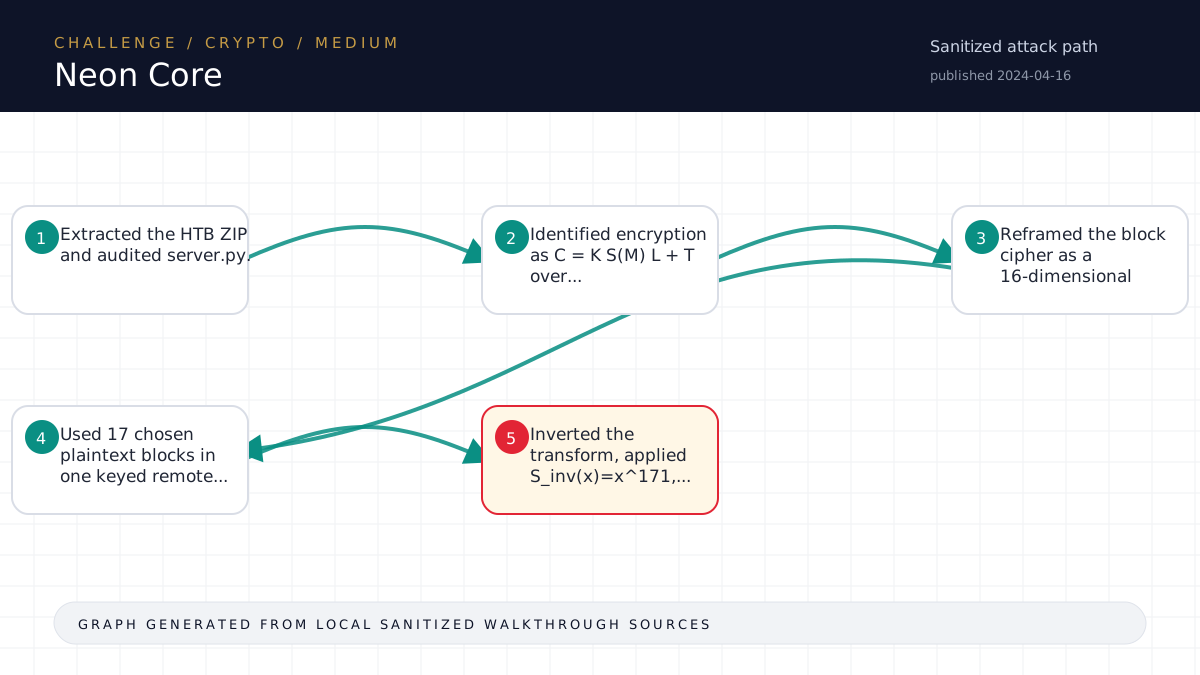
Walkthrough flow
Extracted the HTB ZIP and audited server.py.
Identified encryption as C = K S(M) L + T over...
Reframed the block cipher as a 16-dimensional affine...
Used 17 chosen plaintext blocks in one keyed remote...
Inverted the transform, applied S_inv(x)=x^171,...
Source coverage
High source coverage
Status: complete. This article is generated from 4 sanitized Markdown sources and keeps raw flags, credentials, keys, cookies, and reusable secrets out of the rendered blog.
High confidence: the page is reconstructed from a primary walkthrough plus multiple supporting notes or evidence sources. Treat the chain as source-backed, while still checking the listed source files for sensitive values.
- Crypto/Neon-Core/writeup.md
- htb-challenge/Crypto/Neon-Core/notes.md
- htb-challenge/Crypto/Neon-Core/memory-summary.md
- htb-challenge/Crypto/Neon-Core/hypothesis-board.md
Technical Walkthrough
Writeup
Challenge
- Name: Neon-Core
- Category: Crypto
- Difficulty: Medium
- Mode: hybrid
Summary
Neon Core is a source-backed remote crypto challenge. The provided server.py encrypts a padded 16-byte block by applying a known byte-wise S-box and then a fixed affine matrix transformation over GF(257). Because the same keyed transform is used for attacker-chosen messages and the encrypted blueprint, the transform can be learned and inverted.
Artifact Inventory
The artifact is a <password redacted> HTB ZIP:
files/a12c7356-7a56-47fb-b6e7-ed9b1812452c.zip- extracted source:
files/extracted/crypto_neon_core/server.py
The remote service is <TARGET>:31023. The source audit is recorded in analysis/source-audit.md.
Analysis
The source defines:
C = K * S(M) * L + T
S(x) = x^3 over GF(257)
S_inv(x) = x^171
Flattened into a 16-element vector, this is an affine map:
vec(C) = A * vec(S(M)) + vec(T)The chosen-plaintext oracle gives enough equations to recover A and the offset. The solver uses a one-block calibration strategy:
- baseline: 15
Acharacters, so the final byte is PKCS#7 padding0x01 - positions 0-14: replace one
AwithBto recover each column - position 15: compare a 14-byte message, where the last two bytes become padding
0x02, then subtract the known position-14 contribution
The deployed service had a protocol quirk: repeated interactive queries on the same connection closed unexpectedly, but pre-sending all menu choices in one connection worked and kept the same random matrices for all calibration queries and the blueprint request.
The ciphertext encoder also has an edge case: field element 256 is serialized as 100, while normal byte-sized values are two hex characters. The solver parses mixed-width candidates and accepts the candidate that decrypts to valid PKCS#7 and the expected HTB flag format.
Solve
The reproducible solver is:
python3 Crypto/Neon-Core/solve/solve.py --host <TARGET> --port 31023 --workspace Crypto/Neon-CoreIt records redacted run metadata in analysis/solve-run-redacted.json and stores the raw flag in loot/flag.txt.
Flag
Raw flag is stored in loot/flag.txt and intentionally not reproduced here.
Lessons
- A known nonlinear layer followed by a fixed affine layer is still vulnerable to chosen-plaintext linearization.
- Source-provided finite-field ciphers should be modeled exactly; no floating-point math is needed.
- Remote service behavior may differ from the source loop. If keys are per process, batching menu inputs can preserve one keyed session.
- Encoding field elements as variable-width hex needs explicit parsing.
Source-Backed Dossier
The sections below are merged from companion Markdown notes for the same case. They are rendered after sanitization so the article stays precise without publishing raw flags, credentials, or target-specific secrets.
Notes
Scope
- Challenge: Neon-Core
- Category: Crypto
- Difficulty: Medium
- Mode: hybrid
- Remote instance: <TARGET>:31023
- Start time: 2026-06-11T12:45:17Z
- Operator: harness
- State file:
challenge-state.json
Harness Status
- Current phase: see
challenge-state.json - Next allowed actions: see
next-action.json - Raw flags and sensitive material stay in
loot/only. Do not paste them here.
Artifact Inventory
| File | Size | SHA256 | Type | Notes |
|---|---|---|---|---|
files/a12c7356-7a56-47fb-b6e7-ed9b1812452c.zip | 1190 | <hash redacted> | Zip archive data, at least v1.0 to extract, compression method=store | zip entries: 2 shown in artifact inventory JSON |
Evidence Ledger
| Time | Action | Output/File | Finding | Confidence | Next |
|---|---|---|---|---|---|
| 2026-06-11T12:45:17Z | harness init | challenge-state.json | Workspace initialized with deterministic state file | High | Inventory artifacts |
| 2026-06-11T12:45:28Z | artifact inventory | analysis/artifact-inventory.json | 1 artifact(s) inventoried | High | Build or update hypotheses |
| 2026-06-11T12:45:43Z | hypothesis recorded | hypothesis-board.md | Audit server.py for a flawed custom cipher or oracle interaction, then reproduce locally before remote queries | Medium | Read server.py, identify primitive/oracle/flag flow, and build a local solver against the same functions before connecting to <TARGET>:31023 |
| 2026-06-11T12:45:43Z | research task | analysis/research/task-20260611T124543649041Z-0265298b.md | Research task created for advisory investigation | Medium | Record research output |
| 2026-06-11T12:47:53Z | source audit | analysis/source-audit.md | Source audit recorded | High | Gate before exploit |
| 2026-06-11T12:47:53Z | checkpoint recorded | analysis/checkpoint-analysis-20260611T124753522929Z-d414d7f2.md | Checkpoint for ANALYSIS | High | Use checkpoint to drive next decision |
| 2026-06-11T12:47:53Z | instrumentation plan | analysis/instrumentation-plan.md | Recover and invert the Neon Core affine encryption map with minimal remote oracle calls. | High | Stop if ciphertext parsing is ambiguous without a valid HTB plaintext, if the affine matrix is singular, or if the remote service protocol differs from server.py. |
| 2026-06-11T12:48:02Z | RAG query | analysis/rag/rag-query-20260611T124753558509Z-5ba305d8.txt | RAG helper exited 0; output saved | Medium | Record retrieval tag and validation |
| 2026-06-11T12:48:25Z | RAG record | analysis/rag-records.md | Retrieved memory tagged MISSING | Medium | Validate or reject with live evidence |
| 2026-06-11T12:48:45Z | local memory search | analysis/research/local-memory-search-20260611T124845602120Z-c679c2bc.md | Found 5 safe prior-note result(s) | Medium | Record useful result or skip |
| 2026-06-11T12:49:28Z | local memory record | analysis/local-memory-records.md | Prior local notes reviewed as fallback/advisory context | Medium | Validate against current evidence |
| 2026-06-11T12:49:37Z | evaluator | analysis/evaluator-20260611T124937807273Z-d2a79da2.md | Proceed | High | Run the finite-field solver against <TARGET>:31023, capture only the resulting HTB flag into loot/flag.txt, and stop if protocol or parsing assumptions fail. |
| 2026-06-11T12:56:07Z | flag capture | loot/flag.txt | HTB-format flag captured; raw value kept in loot only | High | Write solution and run completion gate |
| 2026-06-11T12:57:50Z | completion gate | challenge-state.json | Completion gate passed; state marked COMPLETE | High | Optional sanitized memory summary approval |
Key Findings
- The archive is the standard HTB <password redacted> ZIP and extracts to
crypto_neon_core/server.py. server.pyuses Sage-styleGF(257)matrices. Each plaintext block is transformed asC = K S(M) L + T, whereS(x)=x^3.- Since
gcd(3, 256)=1, the S-box is invertible overGF(257)withS_inv(x)=x^171. - The block transform is affine in the vector of S-box outputs. Chosen plaintext encryption lets us recover the full 16x16 affine map.
- The deployed service closes when used interactively for repeated follow-up actions, but it processes a pre-sent batch of menu inputs in one keyed process. The final solver uses this batch behavior.
solve/solve.pysends 17 calibration encryption requests plus the blueprint request in one connection, learns the affine map, handles256 -> "100"mixed-width ciphertext encoding, decrypts the blueprint, and writes the raw flag toloot/flag.txt.- RAG had no matching Neon Core guidance. The solve is based on direct source audit plus local fallback notes about exact algebraic inversion.
RAG / Advisory Memory
RAG output is advisory only. Record evaluated retrievals with:
scripts/challenge_harness.py rag-record <workspace> --query "..." --tag MATCHED|PARTIAL|MISSING|<secret redacted>|GENERIC --validation "..."Secrets/Flags
Raw flags and sensitive material stay in loot/ only. Use scripts/challenge_harness.py capture-flag to validate and record flag capture without printing the value.
Memory Summary
Metadata
- Platform: HackTheBox Challenges
- Category: Crypto
- Challenge: Neon-Core
- Difficulty: Medium
- Source workspace:
<local workspace>
Validated Solve Chain
Concepts only. Do not include raw flags, reusable credentials, tokens, cookies, private keys, or live secrets.
- Extracted the HTB ZIP and audited
server.py. - Identified encryption as
C = K S(M) L + ToverGF(257), withS(x)=x^3. - Reframed the block cipher as a 16-dimensional affine map after an invertible S-box.
- Used 17 chosen plaintext blocks in one keyed remote session to recover the affine transform.
- Inverted the transform, applied
S_inv(x)=x^171, removed PKCS#7 padding, and recovered the HTB-format flag.
Reusable Lessons
- For source-backed custom ciphers, flatten matrix operations and look for affine structure.
- Chosen plaintext often turns nonlinear-looking constructions into exact linear algebra if the nonlinear layer is known and invertible.
- If a service uses per-process random keys and closes after one interactive action, test pre-sending all menu inputs in one connection.
- When
GF(257)values are serialized as hex, handle the256 -> "100"variable-width token.
Dead Ends
- Initial interactive solver assumed the service loop allowed repeated live prompts. The deployed wrapper closed after a single action, so the solver was changed to batch all inputs.
- RAG did not contain useful Neon Core-specific guidance.
Tool Quirks
sageandsympywere unavailable locally, but pure Python modular arithmetic and Gauss-Jordan inversion over modulus 257 were enough.- The remote output marker differed slightly from the provided source: deployed service used
Encrypted configuration (hex):.
Evidence Paths
analysis/source-audit.mdanalysis/instrumentation-plan.mdanalysis/solve-run-redacted.jsonsolve/solve.pyloot/flag.txt
Ingestion Decision
- Proposed for LightRAG: yes, sanitized only
- Requires user approval before ingestion: yes
Hypothesis Board
Keep no more than 3 active hypotheses on Easy/Medium and 5 on Hard unless the user explicitly asks for breadth.
| Rank | Path | Evidence | Missing Proof | Cheapest Validation | Confidence | Status |
|---|---|---|---|---|---|---|
| 1 | Audit server.py for a flawed custom cipher or oracle interaction, then reproduce locally before remote queries | Archive contains a single crypto_neon_core/server.py source file and the challenge provides a remote service | Read server.py, identify primitive/oracle/flag flow, and build a local solver against the same functions before connecting to <TARGET>:31023 | Medium | Active |
Closed Branches
| Branch | Evidence Tested | Failure Output | Reason Closed | Revisit Condition |
|---|
Technical analogy
How to remember this solve
Think of the challenge like a locked box where the lock is mathematical but slightly flawed. The goal is not to smash the box; it is to notice which part of the lock repeats, leaks, or trusts the wrong assumption.
For Neon Core, keep the mental model simple: identify the trusted assumption, prove it with the smallest safe test, then automate or repeat only the part that directly leads to the flag.