
Broken Decryptor
Broken Decryptor is a sanitized challenge note from the local HTB archive, organized for quick review by category, difficulty, evidence flow, and reusable operator
Scenario
Broken Decryptor attack path
Broken Decryptor is a sanitized challenge note from the local HTB archive, organized for quick review by category, difficulty, evidence flow, and reusable operator
Objective
Challenge walkthrough focused on Crypto evidence, validation, and reusable operator lessons.
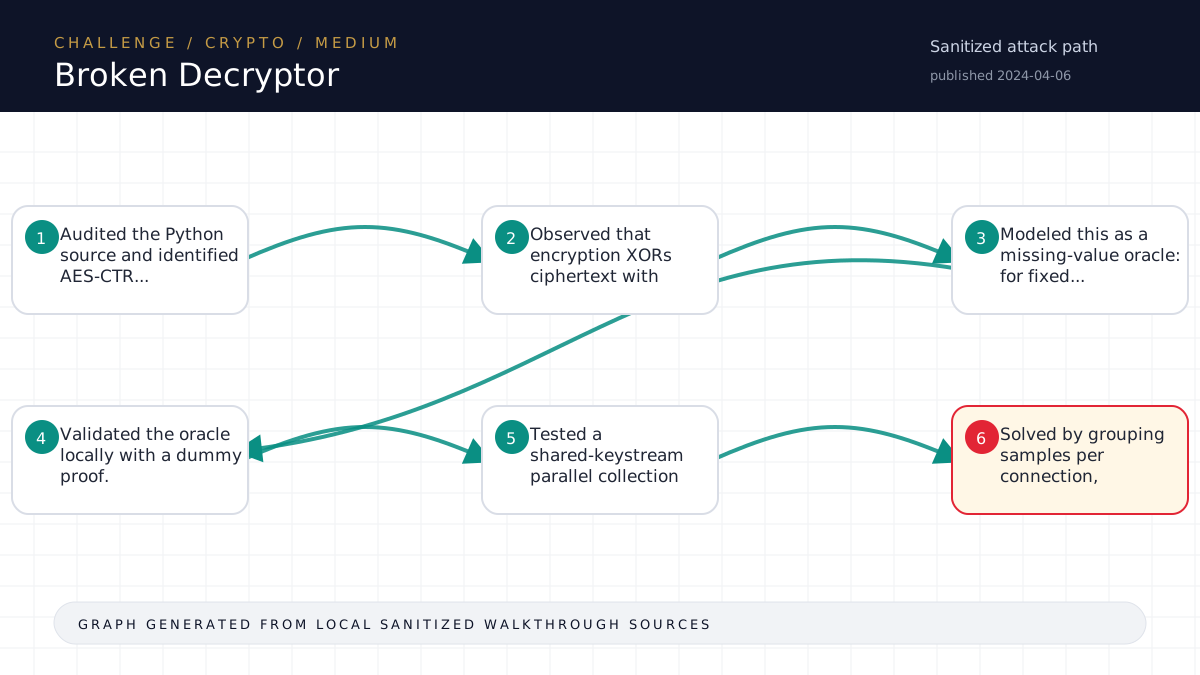
Walkthrough flow
Audited the Python source and identified AES-CTR...
Observed that encryption XORs ciphertext with random...
Modeled this as a missing-value oracle: for fixed...
Validated the oracle locally with a dummy proof.
Tested a shared-keystream parallel collection branch...
Source coverage
High source coverage
Status: complete. This article is generated from 4 sanitized Markdown sources and keeps raw flags, credentials, keys, cookies, and reusable secrets out of the rendered blog.
High confidence: the page is reconstructed from a primary walkthrough plus multiple supporting notes or evidence sources. Treat the chain as source-backed, while still checking the listed source files for sensitive values.
- Crypto/Broken-Decryptor/writeup.md
- htb-challenge/Crypto/Broken-Decryptor/notes.md
- htb-challenge/Crypto/Broken-Decryptor/memory-summary.md
- htb-challenge/Crypto/Broken-Decryptor/hypothesis-board.md
Technical Walkthrough
Writeup
Challenge
- Name: Broken-Decryptor
- Category: Crypto
- Difficulty: Medium
- Mode: hybrid
Summary
The provided source implements an AES-CTR service with a broken decrypt menu and a flawed encrypt menu. The encrypt function resets CTR to the same IV for each request, then XORs the ciphertext with random bytes where 0x00 is replaced by 0xff.
That replacement creates a missing-value oracle: for any fixed plaintext byte and position, every output byte can appear except plaintext_byte xor keystream_byte. Repeating zero encryptions and flag encryptions reveals two missing-value vectors; XORing those vectors recovers the flag.
The live deployment used fresh key/IV state per connection, so samples could not be mixed across sockets. The final solve grouped samples per connection, computed possible flag-byte candidates from each connection, and intersected the candidate sets until every flag byte was unique.
Artifact Inventory
files/a12c734a-18b6-4899-89cf-e9bc932b3f4b.zip: original challenge archive.analysis/extracted/challenge.py: complete Python service source.- Remote service:
<TARGET>:31068. - Hashes and file type details are in
analysis/artifact-inventory.json,analysis/file-types.txt, andanalysis/sha256sums.txt.
Analysis
Relevant source behavior from analysis/extracted/challenge.py:
keyandivare generated at process startup.encrypt(data)constructs a fresh AES-CTR object with the same counter initial value each call.- The encrypt output is:
data xor keystream xor otpotpcomes fromos.urandom(len(data)).replace(b'\x00', b'\xff').- Therefore an OTP byte can never be zero, and byte value
0xffis twice as likely as ordinary values. - For fixed plaintext and position, the impossible output value is
plaintext_byte xor keystream_byte.
The decrypt path is not useful. main() passes decrypt(unhex(ct)), so decrypt() receives bytes, but then calls data.encode(), which raises and is swallowed by the broad exception handler.
Local validation:
analysis/local-simulation.txtandanalysis/local-simulation-latest.txtshow the missing-value recovery works against a dummy flag under the same distribution.analysis/remote-solve.txtclosed the first remote branch: mixing multiple sockets as if they shared one keystream produced impossible evidence for a single keystream.analysis/remote-intersection-solve.txtshows the final per-connection intersection run. Round one resolved all positions uniquely.
Solve
The solve script is solve/solve.py.
The final remote command used:
cd <local workspace>
python3 -u solve/solve.py \
  --host <TARGET> \
  --port 31068 \
  --strategy intersection \
  --workers 20 \
  --per-worker-samples 750 \
  --rounds 2 \
  --output loot/flag-candidate.txt
The script:
- Opens independent connections.
- For each connection, collects repeated
get_flagand zero-plaintext encryption samples. - Builds candidate flag-byte sets from missing output values within that connection only.
- Intersects candidate sets across connections.
- Stops when every position has one printable candidate and the result matches the expected HTB flag format.
The harness then copied the validated candidate to loot/flag.txt.
Flag
Raw flag is stored in loot/flag.txt and intentionally not reproduced here.
Lessons
- When randomness excludes one byte value, repeated outputs can become a missing-value oracle.
- Do not assume source-level process globals are shared across remote sockets; validate deployment behavior.
- If each connection has independent crypto state, compute per-connection candidate sets and combine only the final plaintext candidates.
Source-Backed Dossier
The sections below are merged from companion Markdown notes for the same case. They are rendered after sanitization so the article stays precise without publishing raw flags, credentials, or target-specific secrets.
Notes
Scope
- Challenge: Broken-Decryptor
- Category: Crypto
- Difficulty: Medium
- Mode: hybrid
- Remote instance:
<TARGET>:31068 - Start time: 2026-06-13T12:57:32Z
- Operator: harness
- State file:
challenge-state.json
Harness Status
- Current phase: see
challenge-state.json - Next allowed actions: see
next-action.json - Raw flags and sensitive material stay in
loot/only. Do not paste them here.
Artifact Inventory
| File | Size | SHA256 | Type | Notes |
|---|---|---|---|---|
files/a12c734a-18b6-4899-89cf-e9bc932b3f4b.zip | 993 | <hash redacted> | Zip archive data, at least v2.0 to extract, compression method=deflate | zip entries: 1 shown in artifact inventory JSON |
Evidence Ledger
| Time | Action | Output/File | Finding | Confidence | Next |
|---|---|---|---|---|---|
| 2026-06-13T12:57:32Z | harness init | challenge-state.json | Workspace initialized with deterministic state file | High | Inventory artifacts |
| 2026-06-13T12:57:51Z | artifact inventory | analysis/artifact-inventory.json | 1 artifact(s) inventoried | High | Build or update hypotheses |
| 2026-06-13T12:58:53Z | hypothesis recorded | hypothesis-board.md | Use repeated encryptions as a missing-value oracle: query encrypt(00..00) to recover the fixed AES-CTR keystream byte-by-byte, query get_flag repeatedly to recover flag^keystream byte-by-byte, then XOR the two missing-value vectors. | High | Build a local simulator from challenge.py semantics with a dummy flag, verify recovered flag, then run the same collection against the live service. |
| 2026-06-13T12:58:53Z | source audit | analysis/source-audit.md | Source audit recorded | High | Gate before exploit |
| 2026-06-13T12:59:49Z | research task | analysis/research/task-20260613T125949136851Z-b2449c50.md | Research task created for advisory investigation | Medium | Record research output |
| 2026-06-13T12:59:49Z | research record | analysis/research/research-records.md | Research tagged MATCHED | Medium | Validate against current evidence |
| 2026-06-13T13:01:11Z | checkpoint recorded | analysis/checkpoint-analysis-20260613T130111405483Z-46d8b286.md | Checkpoint for ANALYSIS | High | Use checkpoint to drive next decision |
| 2026-06-13T13:01:11Z | instrumentation plan | analysis/instrumentation-plan.md | Prove and exploit the missing-value oracle created by AES-CTR keystream reuse plus nonzero random mask bytes. | High | Stop if the service closes, sample lengths change, or missing-value sets do not converge by --max-samples. |
| 2026-06-13T13:01:44Z | local memory record | analysis/local-memory-records.md | Prior local notes reviewed as fallback/advisory context | Medium | Validate against current evidence |
| 2026-06-13T13:01:44Z | evaluator | analysis/evaluator-20260613T130144259174Z-2e5e8db7.md | Proceed | High | Run gate before exploit, execute solve.py against the live service, then capture-flag. |
| 2026-06-13T13:08:51Z | instrumentation plan | analysis/instrumentation-plan.md | Prove and exploit the missing-value oracle created by AES-CTR keystream reuse plus nonzero random mask bytes. | High | Stop if sample lengths change, workers error repeatedly, or missing-value sets do not converge by --max-samples. |
| 2026-06-13T13:08:51Z | evaluator | analysis/evaluator-20260613T130851440007Z-44ed1b5e.md | Proceed | High | Run exploit gate again, execute parallel remote solve, then capture-flag. |
| 2026-06-13T13:16:07Z | branch closed | hypothesis-board.md | Aggregating zero-plaintext samples across workers observed all 256 byte values at some positions, which is impossible for one fixed keystream. The live deployment appears to issue fresh key/iv per connection. | High | Rerank hypotheses |
| 2026-06-13T13:16:07Z | instrumentation plan | analysis/instrumentation-plan.md | Recover the flag from per-connection missing-value candidate intersections without mixing different key/iv states. | High | Stop if no worker returns candidate sets, if candidate intersections do not converge within configured rounds, or if recovered bytes fail HTB format. |
| 2026-06-13T13:16:07Z | evaluator | analysis/evaluator-20260613T131607422286Z-c15c72d6.md | Proceed | High | Run gate, execute intersection collector, then capture-flag if a single HTB-format candidate is produced. |
| 2026-06-13T13:46:45Z | flag capture | loot/flag.txt | HTB-format flag captured; raw value kept in loot only | High | Write solution and run completion gate |
| 2026-06-13T13:48:02Z | completion gate | challenge-state.json | Completion gate passed; state marked COMPLETE | High | Optional sanitized memory summary approval |
Key Findings
analysis/extracted/challenge.pyis the full service source.- The service uses AES-CTR, but recreates the counter from the same
ivon every encryption inside one process. encrypt(data)returnsAES_CTR(data) xor otp, whereotpis random bytes with0x00replaced by0xff.- Because
otpcan never contain0x00, each byte position has exactly one impossible output value for a fixed plaintext and keystream. - Repeated zero-plaintext encryption samples reveal the missing keystream byte per position.
- Repeated flag encryption samples reveal the missing
flag_byte xor keystream_byteper position. - XORing those two missing-value vectors recovers the flag for one key/IV context.
- The live service did not behave as a single global key/IV across sockets; mixed parallel samples observed all 256 values for zero plaintext, so that branch was closed.
- The final solve used independent per-connection candidate sets and intersected them across 20 connections with 750 samples each.
solve/solve.pyreproduces the final collection and writes the candidate toloot/flag-candidate.txt.
RAG / Advisory Memory
RAG output is advisory only. Record evaluated retrievals with:
scripts/challenge_harness.py rag-record <workspace> --query "..." --tag MATCHED|PARTIAL|MISSING|<secret redacted>|GENERIC --validation "..."Secrets/Flags
Raw flags and sensitive material stay in loot/ only. Use scripts/challenge_harness.py capture-flag to validate and record flag capture without printing the value.
Memory Summary
Metadata
- Platform: HackTheBox Challenges
- Category: Crypto
- Challenge: Broken-Decryptor
- Difficulty: Medium
- Source workspace:
<local workspace>
Validated Solve Chain
Concepts only. Do not include raw flags, reusable credentials, tokens, cookies, private keys, or live secrets.
- Audited the Python source and identified AES-CTR reset to the same IV on each encryption request.
- Observed that encryption XORs ciphertext with random bytes after replacing
0x00with0xff. - Modeled this as a missing-value oracle: for fixed plaintext and byte position, exactly one output value is impossible.
- Validated the oracle locally with a dummy flag.
- Tested a shared-keystream parallel collection branch and closed it when live samples showed fresh key/IV behavior per connection.
- Solved by grouping samples per connection, deriving candidate plaintext byte sets, and intersecting candidates across independent connections.
Reusable Lessons
- Missing-byte distributions can be exploitable even when ciphertext is masked with fresh randomness.
- Check remote deployment state before mixing samples across connections.
- Candidate-set intersection can recover plaintext when each connection has independent keystream but the hidden message is constant.
Dead Ends
- Treating all remote connections as one shared key/IV context. Live zero-plaintext samples eventually observed all 256 values, which cannot happen for one fixed missing-value oracle.
Tool Quirks
- The local environment lacked some optional crypto tools (
sympy,z3,sage,pwntools,hashcat), but Python and PyCryptodome were sufficient. - The remote service was slow per request, so the final collector needed bounded parallel per-connection sampling.
Evidence Paths
analysis/extracted/challenge.pyanalysis/source-audit.mdanalysis/research/direct-source-crypto-model.mdanalysis/local-simulation.txtanalysis/remote-solve.txtanalysis/remote-intersection-solve.txtsolve/solve.pyloot/flag.txt
Ingestion Decision
- Proposed for LightRAG: yes
- Requires user approval before ingestion: yes
Hypothesis Board
Keep no more than 3 active hypotheses on Easy/Medium and 5 on Hard unless the user explicitly asks for breadth.
| Rank | Path | Evidence | Missing Proof | Cheapest Validation | Confidence | Status |
|---|---|---|---|---|---|---|
| 1 | Use repeated encryptions as a missing-value oracle: query encrypt(00..00) to recover the fixed AES-CTR keystream byte-by-byte, query get_flag repeatedly to recover flag^keystream byte-by-byte, then XOR the two missing-value vectors. | challenge.py resets AES-CTR with fixed key/iv each request and masks ciphertext with a random byte that can never be zero after replacement. | Need local simulation to determine enough samples for reliable missing-value recovery and a remote script that preserves a single connection/process. | Build a local simulator from challenge.py semantics with a dummy flag, verify recovered flag, then run the same collection against the live service. | High | Active |
Closed Branches
| Branch | Evidence Tested | Failure Output | Reason Closed | Revisit Condition |
|---|---|---|---|---|
| Shared-keystream parallel collection across multiple sockets | analysis/remote-solve.txt | analysis/remote-solve.txt | Aggregating zero-plaintext samples across workers observed all 256 byte values at some positions, which is impossible for one fixed keystream. The live deployment appears to issue fresh key/iv per connection. | Only revisit if a single server process/global key is proven live; otherwise keep samples grouped per connection. |
Technical analogy
How to remember this solve
Think of the challenge like a locked box where the lock is mathematical but slightly flawed. The goal is not to smash the box; it is to notice which part of the lock repeats, leaks, or trusts the wrong assumption.
For Broken Decryptor, keep the mental model simple: identify the trusted assumption, prove it with the smallest safe test, then automate or repeat only the part that directly leads to the flag.